Whodunnit Puzzles With Answers: 3 Fair Cases to Solve
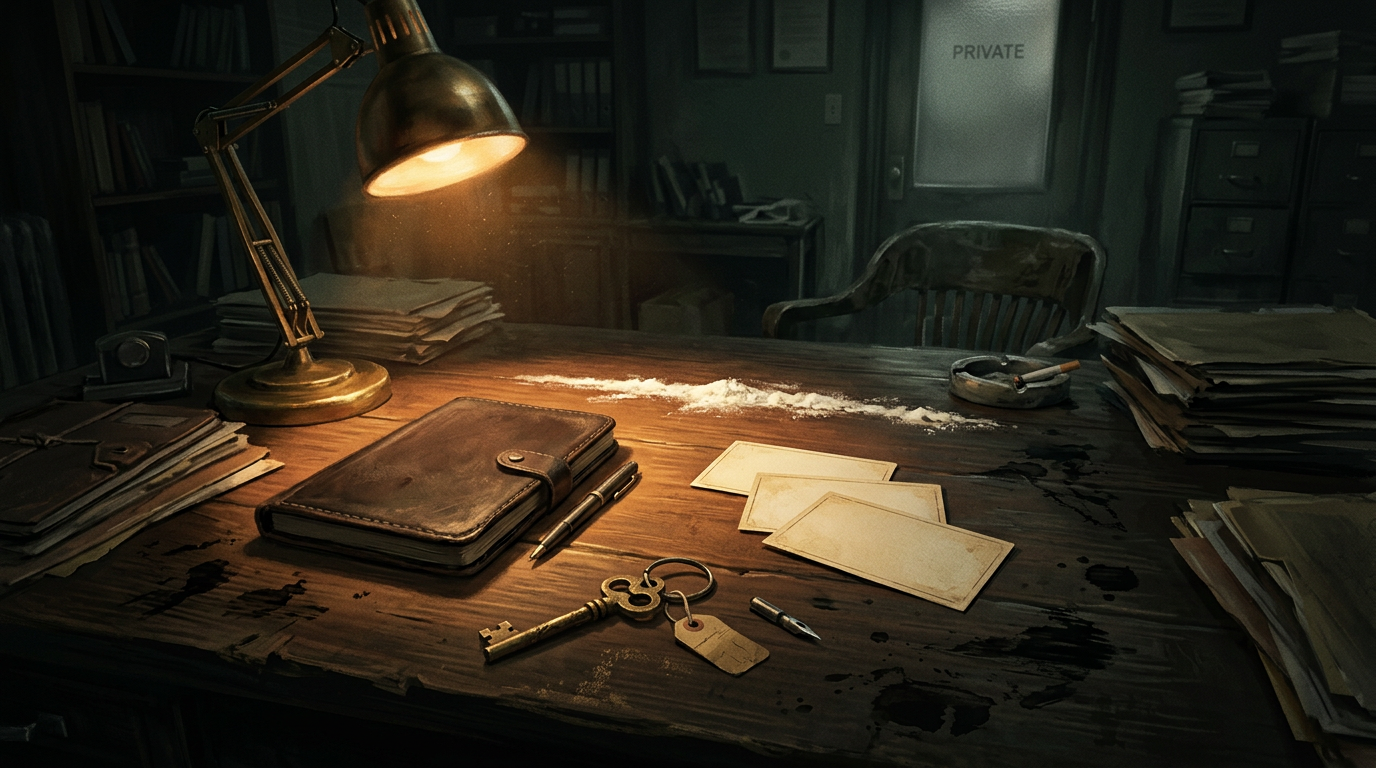
Whodunnit puzzles with answers give you a compact mystery to solve: study the clues, decide who is responsible, then check the reasoning. The best ones make the answer deducible from information in the puzzle—not from a lucky guess or a detail revealed afterward.
Key takeaways
- Read the full setup before making an accusation; small rules often carry the case.
- Look for a clue that separates one suspect from the others, then test every possibility.
- The three original puzzles below range from easy to medium and have solutions at the end.
- A fair answer explains why the other suspects do not fit, not merely who did it.
What makes whodunnit puzzles with answers satisfying?
A whodunnit puzzle asks you to identify the person responsible for an event, usually by comparing suspects, statements, timelines or physical clues. It may be a short riddle with a single decisive detail, or a longer logic problem that asks you to combine several facts. Either way, the answer should follow from what you were told.
That distinction matters. A surprising reveal is not automatically a fair reveal. If the solution depends on an unstated fact—say, that a suspect cannot read a clock, or that a window was secretly painted shut—the reader had no proper chance to solve it. A satisfying mystery lets you look back and see the route clearly. The trail may have been discreet; it should not have been invisible.
The answer is part of the puzzle, too. A useful explanation names the decisive clue, shows how it rules out alternatives and makes any assumptions explicit. “It was the butler” is a result. “It was the butler because the door log places him inside during the only possible window, while the other two were elsewhere” is reasoning.
How should you solve a whodunnit puzzle?
Before you look at an answer key, give yourself a moment to build a small case file. You do not need a wall of string. A scrap of paper will do.
- List the suspects and the known facts. Keep what the puzzle states separate from what you merely suspect. A confident alibi is not the same as a verified alibi.
- Mark the time window. If the event happened between two known times, cross off anyone who could not have been present—provided the puzzle establishes where they were.
- Translate statements into simple claims. “Mara says Lee was in the library” becomes a claim about Lee’s location. This makes truth-and-lie puzzles easier to test.
- Check every candidate. Try each suspect as the culprit and see whether that choice makes all the clues consistent. If two candidates still fit, the puzzle may be underspecified.
- Make an accusation before reading the solution. Write down both the name and the clue that convinced you. If you cannot explain the second part, the guess may be ahead of the evidence.
For a longer method, see this step-by-step guide to solving a murder mystery. It offers a useful habit for short riddles too: record what is known before deciding what it means.
Three whodunnit puzzles with answers to try
The puzzles here are original and self-contained. Each includes the rules needed to solve it. Try them in order, and stop before the answer key if you want a clean run. There are no hidden accomplices, secret passages or late-arriving witnesses. The old-fashioned standards still apply.
Puzzle 1 — The missing invitation (easy)
A signed invitation disappears from a desk. Three people are suspects: Ava, Basil and Cora. They make these statements:
- Ava: “Basil took the invitation.”
- Basil: “Cora took the invitation.”
- Cora: “Basil did not take the invitation.”
The detective establishes that exactly two of the three statements are true. Who took the invitation?
Puzzle 2 — The archive medal (medium)
A medal goes missing from a secured archive between 14:04:00 and 14:06:00. Only Lena, Omar and Priya had access to the archive during that period. The door uses personal badges, which cannot be lent, and its complete log records every entry and exit.
The log shows:
| Suspect | Archive entry | Archive exit |
|---|---|---|
| Lena | 13:58:00 | 14:02:00 |
| Omar | 14:04:20 | 14:07:00 |
| Priya | 14:07:10 | 14:09:00 |
The medal was confirmed present at 14:04:00 and missing at 14:06:00. Who took it?
Puzzle 3 — The floury corridor (medium)
A brass key disappears from a study. The only route between the study and the house’s front door crosses a strip of fresh flour laid across the floor at 21:55. The flour was clean and undisturbed when laid. All three suspects were in the house, and each had to cross the strip to leave. Nobody changed shoes, and there was no other source of flour.
After the key is found missing, the housekeeper checks the suspects’ shoes. Only one pair has fresh flour on its soles: Noor’s. Who took the key?
How do you know a puzzle is fair?
Fairness is not the same as ease. A hard puzzle can still be fair if it gives you every fact you need; an easy one can feel arbitrary if its decisive clue appears only in the explanation. Use these checks before you trust an answer—or write a puzzle of your own.
| Fair-play check | What to look for | Warning sign |
|---|---|---|
| Complete setup | Rules, timing and relevant limits are stated | The solution introduces a new fact |
| Unique answer | Only one suspect fits every clue | Two suspects remain equally possible |
| Clear inference | The explanation connects clue to conclusion | The answer relies on “obviously” or “must have” without proof |
| Useful exclusion | Other suspects are ruled out by evidence | The culprit is named without addressing alternatives |
Puzzle collections often make answers easier to avoid by hiding them or placing them after the puzzles. For example, one collection describes answers behind toggles and four difficulty tiers; another groups its riddles by difficulty and offers a printable PDF. Those are page-specific formats, not a universal standard. See the toggle-and-tier format and the difficulty groups and printable option for examples.
A practical rule: if the answer needs a new fact, it is not a deduction. If the explanation does not show why alternatives fail, it is not yet a complete solution. And if the mystery has more than one defensible answer, that may be an interesting discussion—but it is not a clean logic puzzle.
Common mistakes when solving detective riddles
Treating every statement as a fact. A suspect’s claim is evidence about what they say, not proof that their account is true. In a truth-and-lie puzzle, evaluate each statement against the scenario rather than accepting it at face value.
Assuming a familiar trick. A stopped clock, a wet umbrella or a left-handed suspect may sound like a clue because you have seen similar riddles. Familiarity does not make it relevant. Use only details the puzzle connects to the event.
Ignoring the exact wording. “At 14:04” and “between 14:04:00 and 14:06:00” are not interchangeable. Timing, access rules and words such as “only” can do substantial work. Read them as carefully as a witness statement.
Stopping at the first plausible suspect. A person may have had opportunity without being the only person with opportunity. Test every suspect against the complete set of clues, including the ones that seem to support your favourite alternative.
Mistaking a clever reveal for a fair one. If the solution depends on an unstated assumption, challenge the puzzle rather than blaming your instincts. A good answer should survive a reread without requiring the reader to pretend they knew more than the page said.
For a focused practice set, try three detective riddles with answers. The same standard applies: look for one supported answer, not merely a neat-sounding twist.
Want a longer case than a one-minute riddle?
Short riddles deliver a quick accusation and a quick verdict. A full case file asks you to hold more details in mind, compare accounts and decide when the evidence is sufficient. That is a different sort of evening: fewer instant reveals, more careful notes.
CaseZero is a fictional detective game played in a browser. Its free first case, #0001 The Last Guest, requires no account. For a longer option, Case Pack 01 is €12.99 and includes The Silent Floor, Dead Letter and The Second Key. These are cases to investigate, not a bundle of short riddles. The public teaser puts the mood plainly: “Six people sat down to dinner. Five of them lied about it.” No solution is needed here; the point is to follow the evidence for yourself.
In a longer interactive case, you can review evidence, question suspects in your own words, build a timeline and make one accusation. If that sounds appealing, browse the CaseZero case library. You can also stay with short puzzles; a tidy mystery does not require an entire evening or a corkboard.
Solution: answers and reasoning
Puzzle 1 — Cora took the invitation
Test each suspect in turn. If Ava took it, Ava’s statement is false, Basil’s statement is false, and Cora’s statement is true: only one statement is true. If Basil took it, Ava’s statement is true, while Basil’s and Cora’s are false: again, only one is true. If Cora took it, Ava’s statement is false, Basil’s is true, and Cora’s is true. That gives exactly two true statements, as required. So Cora is the only answer that fits.
Puzzle 2 — Omar took the medal
The medal was present at 14:04:00 and missing at 14:06:00, so the person responsible had to be in the archive during that window. Lena left at 14:02:00, before the window began. Priya did not enter until 14:07:10, after the medal was already missing. Omar entered at 14:04:20 and left at 14:07:00, placing him inside during the only possible interval. The personal badge and complete log rule out a borrowed badge or an unrecorded entry.
Puzzle 3 — Noor took the key
The flour strip is the only route between the study and the front door. Everyone’s shoes were clean before the flour was laid, nobody changed shoes, and there was no other flour source. The person responsible had to cross the strip to leave after taking the key. Only Noor’s shoes carry fresh flour, so Noor is the one who crossed it. The clue works because the setup rules out the obvious alternatives; without those rules, flour on a shoe would be suggestive, not conclusive.
A good whodunnit ends with the clues doing the talking. Start with the facts, test each suspect and demand a reasoned answer—not a lucky hunch. If you want to move from compact riddles to a fuller investigation, try #0001 The Last Guest or explore Case Pack 01.
This video is hosted by YouTube. Loading it shares your IP address with Google and may set cookies.
Questions from the squad room
What are some good whodunnit puzzles with answers?
Start with puzzles that provide all the rules and clues upfront, then explain why the answer follows. This guide includes three original examples: a truth-statement puzzle, a timeline case and a physical-evidence puzzle. Their solutions are collected at the end so you can make an accusation first.
Can I try each puzzle before seeing the answer?
Yes. The three puzzles appear together before the answer key, under a separate “Solution” heading near the end. Stop after the puzzle section, write down your suspect and decisive clue, then scroll down when you are ready to check your reasoning.
Are these whodunnit puzzles suitable for beginners?
Yes. The first puzzle is an easy truth-and-lie warm-up, while the archive timeline and flour clue are medium difficulty. Each gives the relevant rules in its setup, so you do not need specialist knowledge or outside information to solve them.
How can I tell whether a whodunnit answer is fair?
A fair answer uses facts stated in the puzzle, fits every clue and rules out the other suspects. If the explanation introduces a new detail or depends on an unstated assumption, the answer is not fully supported. A strong solution shows the reasoning rather than simply naming the culprit.
What is the difference between a detective riddle and a longer mystery game?
A detective riddle is usually a compact puzzle with a small cast and a short deduction. A longer mystery game asks you to review a fuller case, compare evidence and accounts, and build a broader explanation. Both reward careful reasoning, but they offer different amounts of investigation.
More from the Casebook
 Puzzles & riddles · 20 Nov 2026 · 8 min
Murder Mystery Logic Puzzles for Adults: A Practical Guide
Murder mystery logic puzzles for adults, explained: compare formats, spot fair clues and try an original mini-puzzle with its solution.
Read the file Puzzles & riddles · 16 Nov 2026 · 9 min
Detective Riddles With Answers: Three Fair Puzzles to Solve
Detective riddles with answers, fair clues and separated solutions. Try three original puzzles, learn a reliable solving method and avoid common traps.
Read the file Puzzles & riddles · 02 Nov 2026 · 9 min
Murder Mystery Riddles With Answers: 5 Fair Puzzles
Murder mystery riddles with answers: try five original, fair puzzles, then read the reasoning behind each reveal without guesswork or gore.
Read the file