Murder Mystery Logic Puzzles for Adults: A Practical Guide
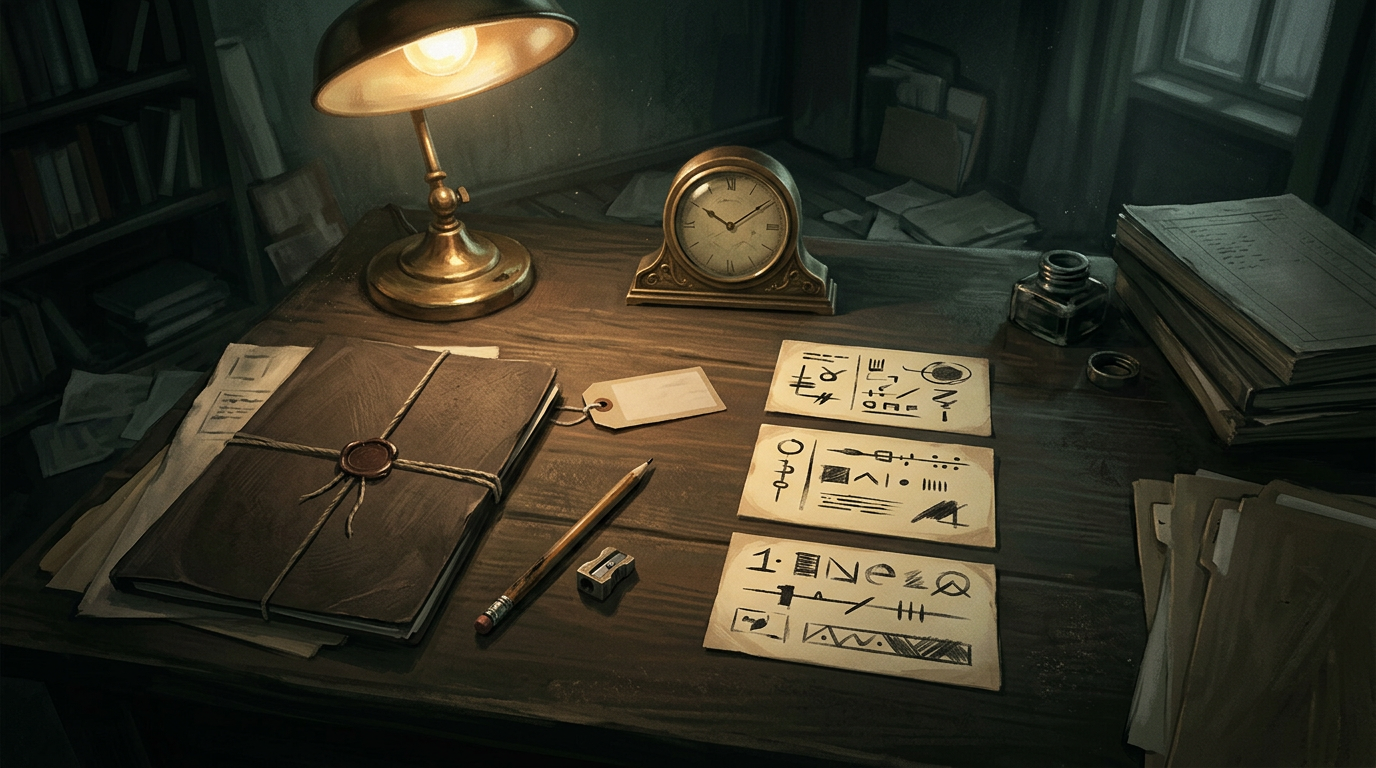
Murder mystery logic puzzles for adults are deduction puzzles that ask you to use clues, timelines and statements to identify what happened, rather than guess at a reveal. The best ones make the answer checkable: each clue narrows the possibilities, and the final conclusion follows from the evidence.
Key takeaways
- Choose a format that matches your available time: a daily grid, a case file, a book or a longer game.
- A fair puzzle gives you the information needed to reach one supported answer.
- Track facts separately from assumptions, then test each theory against every clue.
- You can try a short original puzzle below; its solution is held until the final section.
- “For adults” can mean a more layered puzzle, not graphic content.
What are murder mystery logic puzzles for adults?
Murder mystery logic puzzles for adults combine a whodunnit premise with a reasoning problem. You might compare alibis, match people to places and times, check a timeline, or spot a contradiction in a witness statement. The goal is to reach a defensible conclusion using the information provided.
The format can be very small: a few suspects and a handful of clues on one page. It can also stretch into a case file with documents, interviews and evidence to assess. In either form, the pleasure is the same: a story presents several plausible explanations, and your job is to find which one survives scrutiny.
“Adult” is useful as a description of the intended puzzle experience, but it does not have to mean graphic subject matter. A thoughtful mystery can feel mature through ambiguity, careful reading and layered deduction. If you prefer a gentler tone, check the content description before choosing a game or book.
These puzzles also differ from ordinary riddles. A riddle often hinges on one unusual interpretation of a sentence. A logic mystery should let you combine several clues and verify the result. If the answer depends on a detail you could not reasonably know, that is not deduction; it is a trapdoor.
Which format should you choose?
Start with the kind of solving session you want. A short daily puzzle suits a spare moment; a case file gives you more room to compare documents and revisit a theory. Group murder-mystery kits are designed for discussion, while many logic grids and digital puzzles work well solo.
| Format | What you do | Best fit | What to check |
|---|---|---|---|
| Daily logic puzzle | Deduce a match or culprit from a compact clue set | A short, focused break | Whether the puzzle has hints or an explanation |
| Case-file game | Review evidence, statements and a timeline | Players who enjoy a longer investigation | How much reading and note-taking it involves |
| Puzzle book | Work through a sequence of printed challenges | Offline solving at your own pace | Whether answers and explanations are included |
| Party mystery | Share roles and clues with a group | A planned social evening | Player count, setup and how the host handles the reveal |
Time varies by puzzle and by reader. As one point of comparison, the Daily Holmes guide to detective puzzle games gives estimates ranging from about three minutes for Daily Holmes to 5–20 minutes for Clues by Sam. Those are the publisher’s estimates, not a universal stopwatch. A case file may take longer because reading and comparing material is part of the experience.
If you want to browse digital mysteries, the CaseZero case library lists its public case options. Case #0001, The Last Guest, is free and requires no account. For a paid set, Case Pack 01 contains The Silent Floor, Dead Letter and The Second Key for €12.99. Those are titles and offer details—not a promise that every player will prefer the same format.
For other online formats, Deduce describes its daily puzzle as the same case for all players on a given day. For a print-oriented option, Cludoku lists Murder at the Christmas Bookshop as a 40-case PDF priced at €7.99 on its play page. These examples illustrate different formats; choose by length, presentation and how much explanation you want after solving.
How do you solve a murder mystery logic puzzle step by step?
A calm method beats a dramatic accusation. The point is not to suspect everyone with equal intensity. It is to reduce uncertainty, one reliable fact at a time.
1. Read the question before the clues
Work out exactly what you must identify. Is the puzzle asking for a culprit, a time, a location, or a full set of matches? Keep the requested answer in view. A clue about where someone was may matter only because it rules out a time; it may not identify the culprit by itself.
2. List the known categories
Write down the people and any other categories in play: times, rooms, objects or statements. If each person must have one unique time, mark that rule clearly. For a grid puzzle, make a small table. For a narrative case, use a timeline or a simple evidence ledger.
3. Separate facts from claims
A verified record, a witness’s statement and your interpretation are not the same thing. Label them separately. “The clock log places Bram at 9:20” is a fact if the puzzle says the log is reliable. “Bram had time to do it” is an inference that still needs testing.
4. Translate clues literally
Turn each clue into a plain rule. “Ada arrived before Cora” means Ada’s time is earlier than Cora’s. It does not say how much earlier. Mark exclusions as well as matches: if Bram cannot be at 9:10, cross that option out rather than quietly forgetting it.
5. Combine clues, then check the whole set
One clue may eliminate only one possibility. The useful deduction often comes from combining it with another. When a candidate looks promising, check every clue against that candidate. A theory that fits four clues and contradicts a fifth is not almost right; it is wrong, or your reading needs another look.
6. Make the accusation last
Before settling, ask whether another person could also fit all the evidence. If two candidates remain, you have not finished—or the puzzle may not provide enough information. Avoid using a hunch about who “seems guilty” to fill a gap that the clues have not closed.
For a more detailed solving routine, see this step-by-step guide to solving a murder mystery. If you get stuck on dialogue-based riddles, a list of questions to ask a murder suspect can also help you think about what a question should establish—without treating a confident answer as proof.
What makes a mystery puzzle fair?
A fair logic puzzle provides enough information to support one answer, and it makes the rules clear. If you are told that three people visited at three different times, each person should have one time and each time should be used once. If a clue depends on a clock being accurate, the puzzle should say that the clock is reliable or otherwise establish it.
Fairness does not mean the answer must be obvious. A clue can be indirect, and you may need to combine several facts. But a fair solution should be explainable in a short chain: this clue rules out one option; that leaves one match; the remaining clue confirms it.
Before buying a longer game or book, look for practical signs of a good fit: a sample puzzle, an answer section, explanations rather than bare answer keys, and a description of expected play time. A sample lets you judge the writing and clue density. An explanation helps distinguish a deduction you missed from a conclusion the author simply asserts.
There is a difference between difficulty and obscurity. A difficult puzzle may require several steps. An obscure one withholds a necessary rule, relies on specialist knowledge, or permits multiple solutions. If the solution introduces a fact that was not available in the puzzle, the mystery has not been fairly solved; it has merely been closed.
Can you solve this original mini mystery?
Try the puzzle before scrolling to the final section. All the rules and clues needed to solve it are below. There is one culprit, and no outside knowledge is required.
A sealed envelope in a private office was tampered with during one of three logged visits. The office log is reliable. Ada, Bram and Cora each visited once, at 9:00, 9:10 or 9:20. Each carried a different item: an umbrella, a parcel or a folder. The person who visited at 9:10 is the only person who could have reached the envelope during the relevant interval, so that visitor is the culprit.
Use these clues:
- Bram carried the folder.
- The person who carried the folder visited at 9:20.
- Ada visited earlier than Cora.
- Cora did not visit at 9:00.
Who visited at 9:10?
A useful way to work is to solve the certain match first. Clues 1 and 2 connect Bram to the folder and the folder to 9:20. That fixes Bram’s visit. Then consider the two times left for Ada and Cora. Clues 3 and 4 determine their order, leaving one visitor at 9:10. No claim about personality or motive is required; this is a timing deduction, not a guess about who looks suspicious.
Common mistakes—and the solution
Before checking the answer, watch for three familiar errors. First, do not treat “not at 9:00” as proof of “at 9:10” until you have accounted for the third time. Second, do not infer that two people share a time or object when the puzzle says each one is distinct. Third, do not stop at a candidate that fits most clues; use every clue, including the ones that seem merely confirmatory.
Solution
Bram carried the folder, and the folder carrier visited at 9:20. Therefore Bram visited at 9:20. Ada and Cora must have visited at 9:00 and 9:10, in some order. Ada visited earlier than Cora, and Cora did not visit at 9:00. So Ada must have visited at 9:00 and Cora at 9:10. Since the visitor at 9:10 is the culprit, Cora is the answer.
The important point is not the name; it is that the answer follows from all four clues and leaves no alternative. That is the standard to look for in a satisfying whodunnit: atmosphere may set the scene, but evidence does the actual work.
If you want a case to investigate after the mini-puzzle, try Case #0001 The Last Guest, free with no account. Or, if you prefer a set of three named cases, Case Pack 01 includes The Silent Floor, Dead Letter and The Second Key for €12.99. Read the clues closely. The quiet detail is often the one that keeps the whole story honest.
This video is hosted by YouTube. Loading it shares your IP address with Google and may set cookies.
Questions from the squad room
Are murder mystery logic puzzles for adults different from ordinary riddles?
Usually, yes. A riddle often turns on an unexpected interpretation of a line, while a logic mystery asks you to combine clues—such as times, alibis or locations—and test a conclusion against them. A good puzzle makes its rules clear and gives enough information to support a defensible answer.
Can I solve a murder mystery logic puzzle without guessing?
A fair puzzle should allow you to reach its intended answer through the clues provided. Keep a list of facts, mark exclusions and check your leading theory against every clue. If two suspects still fit equally well, either you have missed a rule or the puzzle may not supply enough information.
What format is best for a short solving session?
A daily logic puzzle or a compact browser puzzle is usually easier to fit into a brief break than a long case file or group game. Time estimates vary by puzzle and player; check the publisher’s description and try a sample when available. Longer formats suit readers who enjoy taking notes and revisiting evidence.
Do “for adults” murder mystery puzzles need graphic content?
No. The phrase can describe puzzle complexity or the intended audience, not graphic material. Many mysteries focus on deduction, testimony and timelines. Check a game or book’s content description if you want to avoid upsetting themes; a mature-feeling mystery can remain restrained and suitable for a general audience.
Is CaseZero free to try?
CaseZero’s public case #0001, The Last Guest, is free and requires no account. Case Pack 01 is listed at €12.99 and contains The Silent Floor, Dead Letter and The Second Key. Those details help you compare the available options before deciding whether to play.
More from the Casebook
 Puzzles & riddles · 18 Nov 2026 · 8 min
Whodunnit Puzzles With Answers: 3 Fair Cases to Solve
Whodunnit puzzles with answers, fair clues and clear reasoning. Try three original cases, check your deductions and choose your next mystery.
Read the file Puzzles & riddles · 16 Nov 2026 · 9 min
Detective Riddles With Answers: Three Fair Puzzles to Solve
Detective riddles with answers, fair clues and separated solutions. Try three original puzzles, learn a reliable solving method and avoid common traps.
Read the file Puzzles & riddles · 02 Nov 2026 · 9 min
Murder Mystery Riddles With Answers: 5 Fair Puzzles
Murder mystery riddles with answers: try five original, fair puzzles, then read the reasoning behind each reveal without guesswork or gore.
Read the file