Detective Riddles With Answers: Three Fair Puzzles to Solve
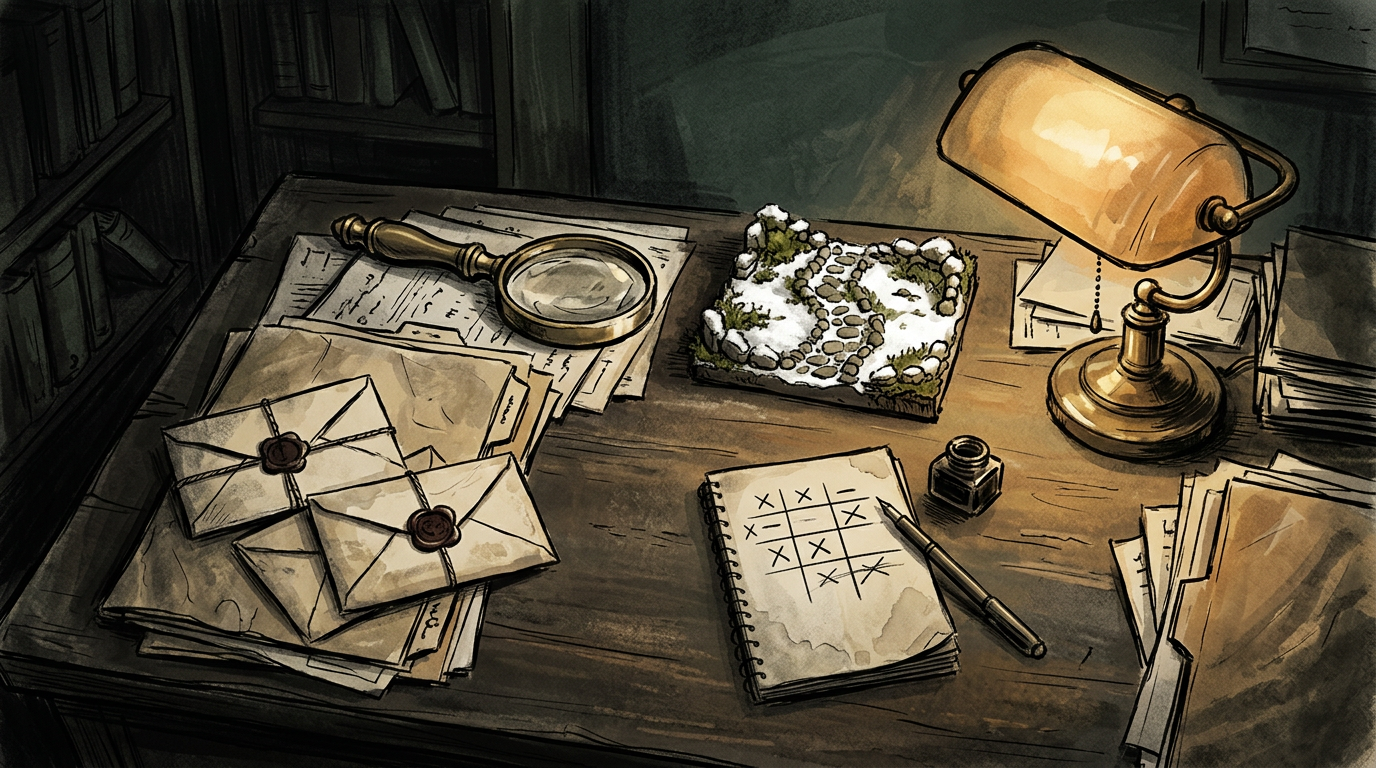
Detective riddles with answers are short mysteries that invite you to spot a contradiction, connect clues or eliminate possibilities before reading the reveal. The best ones give you enough information to solve them fairly—and keep the answer out of sight until you are ready.
Key takeaways
- Read every stated fact before guessing; small constraints often do the work.
- Separate what a suspect claims from what the clues prove.
- A fair riddle has a supported answer, not merely a surprising one.
- Three original puzzles appear below; their solutions are collected near the end.
Detective riddles with answers: three fair puzzles
Try each puzzle before moving on. Note the details that must be true, then ask which statement or possibility cannot fit. The answers are deliberately kept in a separate section below.
1. The garden gate — easy
A caretaker says he left the manor grounds at 8:45 p.m. and returned at 8:55. Snow began falling at 8:30 and continued steadily until 9:00. The garden gate is the only way in or out. The path between the manor and gate was flat, open to the sky and freshly cleared at 8:30. At 9:00, the caretaker’s footprints were the only marks on it: they led from the manor to the gate, but none led back.
Question: Which part of the caretaker’s account is contradicted by the scene?
2. The stopped clock — easy to medium
At a small station, the wall clock is known to be accurate and working. A witness says she looked directly at it at 6:10 p.m. and saw it displaying 6:00. There are no reflections, another clock, or uncertainty about the time. The clock does not have a countdown display.
Question: What can you conclude about the witness’s statement—and what can’t you conclude?
3. The hallway register — medium
Three visitors—Ava, Ben and Cal—entered a building’s hallway at 6:00, 6:05 and 6:10, one person at each time. Each carried a different-coloured umbrella: red, blue or green.
The register and a receptionist’s notes establish these facts:
- Ben carried the red umbrella.
- The person with the blue umbrella entered at 6:10.
- The person with the green umbrella entered at 6:00.
- Cal did not carry the green umbrella.
Question: Who entered at 6:05, and what colour umbrella did that person carry?
How do you solve a detective riddle?
Start with the exact question. A riddle may ask who lied, which event is impossible, or what follows from a set of clues. Those are not interchangeable. A contradiction in an alibi can show that the alibi is false; by itself, it does not establish what the speaker did instead.
1. Sort facts from claims
Write down what the puzzle establishes independently, then list what each person says. “Snow fell continuously” is a stated condition. “I returned by the gate” is a claim to test against it. Keeping the two apart prevents a suspect’s confident account from quietly becoming evidence.
2. Translate language into constraints
Words such as only, exactly, before and continued matter. “The gate is the only way in or out” rules out a back entrance. “One person at each time” means no two visitors can share a time slot. If a clue has two plausible meanings, pause: the wording may need clarification before the puzzle can be solved fairly.
3. Eliminate possibilities carefully
For a logic puzzle, make a small table. For a timeline, order the events. For an alibi, compare each claim with the physical conditions. Remove only options that contradict a stated clue; do not fill gaps with assumptions about what people would usually do.
4. Check whether the answer is uniquely supported
Before settling on a solution, ask whether another explanation also fits every clue. If two suspects could have lied, or two arrangements satisfy the conditions, the puzzle has not identified one answer. That is a flaw in the puzzle—not a failure of your powers of deduction.
For a longer, evidence-led approach, see this step-by-step guide to solving a murder mystery. It covers the broader habit of keeping clues, timelines and conclusions distinct.
What makes a detective riddle fair rather than a trick question?
A fair riddle supplies the information needed to reach its intended answer. The solution may be unexpected, but it should follow from the setup rather than depend on an unstated custom, hidden rule or special definition revealed after the guess.
A useful test is to ask, “Could a careful reader reasonably choose a different answer using only these clues?” If yes, the writer should add a condition or accept that the riddle has more than one valid solution. A clever turn is welcome; a missing fact is not cleverness in a hat.
| Feature | Fair deduction puzzle | Weak gotcha puzzle |
|---|---|---|
| Clues | States the relevant limits and conditions | Hides a necessary rule until the reveal |
| Answer | Follows from the clues and can be checked | Depends on guessing the writer’s intended trick |
| Explanation | Shows why alternatives fail | Repeats the answer without proving it |
| Uncertainty | Acknowledges what the clues do not establish | Claims more than the evidence supports |
Short alibi contradictions are a familiar format, and some riddle collections pair an alibi with a hint and answer. The RiddlePlays detective riddles page provides examples of that structure. Other collections use broader crime-scene scenarios: ThePuzzleLabs describes deduction puzzles built around scenarios, suspects and evidence, with harder ones requiring clues to be combined in its deduction guide.
The difference is not simply length. A one-line puzzle can be fair if it gives every needed fact. A longer mystery can still be unfair if its conclusion depends on information the reader never received.
Which detective riddles suit different players?
“Easy” and “hard” are useful labels, but they are not universal. A quick contradiction may be simple for someone who notices wording and difficult for someone who reads at speed. A logic grid may feel comfortable to one player and laborious to another. Choose a format that suits the moment, not a label that promises a particular score.
| Puzzle type | What you do | Good for |
|---|---|---|
| Alibi contradiction | Compare a statement with a fixed fact or timeline | A quick solo challenge or warm-up |
| Logic arrangement | Match people, times, objects or locations using several clues | Players who enjoy notes and elimination |
| Scene-based deduction | Combine details from a setting, statements and evidence | A slower, more immersive puzzle |
| Timed or video quiz | Look for a visual clue under a time limit | A social or fast-paced challenge |
Search results include collections described as short, timed or intended for different audiences, alongside video quiz formats. Factictionary’s guide, for example, advertises crime-scene riddles and “60-second” puzzles; that describes its presentation, not a rule that every player should solve them in a minute. For a printable group activity, put the puzzles on one page and keep the answer key separate. For solo play, cover the solution section or make a note before scrolling.
If you want more written puzzles after these, CaseZero’s related guide offers murder mystery riddles with answers. Treat any answer key as a check on your reasoning, not a substitute for it.
Common mistakes when solving detective riddles
Jumping to the most suspicious person. A suspicious detail is not automatically proof. First answer the question the puzzle actually asks. If it asks who could not have been at a location, do not leap from that to a complete story about their motives.
Adding ordinary-life assumptions. A riddle may not say that a person used a car, took a shortcut or knew a particular schedule. Unless the setup rules those possibilities out, they remain possible. The writer must close relevant loopholes rather than expect readers to guess which ones count.
Treating a contradiction as a full solution. A false statement establishes that a statement is false. It does not always establish who caused an incident, why they lied or what happened next. Keep your conclusion as narrow as the evidence.
Reading clues in isolation. Some puzzles only resolve when two or more conditions are combined. Make a small grid or timeline rather than relying on memory. This is especially helpful when several people, times and objects are involved.
Skipping the explanation. When you reach an answer, try to explain why it follows and why alternatives fail. If you cannot do that, you may have guessed correctly by chance—or found a gap in the puzzle. Both are useful things to notice.
Want a longer case after the riddles?
A short riddle usually asks you to resolve one contained problem. A longer detective mystery gives you a wider case to examine: you may need to compare statements, track a sequence of events and decide which conclusions the available evidence supports. The pleasure is less “spot the one odd detail” and more “build a theory, then see if it survives inspection.”
If you would like to continue with a browser-based fictional detective game, CaseZero’s free case #0001, The Last Guest is available with no account. For more than one case, Case Pack 01 contains The Silent Floor, Dead Letter and The Second Key for €12.99. These are separate game experiences, not extra answers to the puzzles on this page.
Solutions
Stop here if you have not tried the puzzles. The explanations below use only the facts stated above.
Solution 1: The garden gate
The caretaker says he went out through the gate and returned before 8:55. The path was the only way in or out, snow fell continuously, and the path had no return footprints at 9:00. Under those stated conditions, a return trip should have left a second set of tracks. His account of returning is contradicted. This does not, on its own, establish where he went or why he made the claim.
Solution 2: The stopped clock
If the witness looked at an accurate, working clock at 6:10, it could not display 6:00. The stated claim is impossible as written, so either the witness’s account is wrong or one of the puzzle’s fixed conditions would have to be false. Because those conditions are stipulated as true, the account is the contradiction. Nothing in the puzzle tells us why she said it.
Solution 3: The hallway register
The green umbrella entered at 6:00. Ben carried red, so he was not the green-umbrella visitor. Cal was explicitly not carrying green, so Cal was not that visitor either. Ava must therefore have carried green and entered at 6:00. Blue entered at 6:10, and Ava was already assigned to green; Ben, assigned red, cannot be blue. Cal carried blue and entered at 6:10. Ben is left with the 6:05 slot and the red umbrella.
A good detective riddle rewards attention, not mind-reading. Read the conditions closely, test each conclusion against them, and keep the reveal separate until you are ready. When the short puzzles are done, pick another case and see how far the evidence takes you.
This video is hosted by YouTube. Loading it shares your IP address with Google and may set cookies.
Questions from the squad room
What are some detective riddles with answers?
Try puzzles based on an impossible alibi, a timeline contradiction or a logic arrangement linking people, times and objects. This guide includes three original examples and keeps their solutions in a separate section, so you can solve first and check your reasoning afterward.
How do I solve a detective riddle?
Identify the exact question, separate established facts from what suspects claim, and translate words such as “only” or “exactly” into constraints. Eliminate only options that conflict with a clue. Then check whether the answer is uniquely supported, and avoid claiming more than the evidence proves.
What makes a detective riddle fair?
A fair riddle provides every fact needed to reach its intended answer. Its explanation should show how the clues support that answer and rule out alternatives. If multiple answers fit, or the solution relies on a hidden rule, the puzzle needs clearer conditions rather than a more forceful reveal.
Are detective riddles suitable for children?
Many short deduction puzzles can work for a range of ages, especially when the language is clear and the clues are concrete. Choose a difficulty and subject that fit the reader, and let them attempt the puzzle before showing the answer. The label “easy” is not a guarantee that everyone will find it easy.
Are there longer detective mysteries to try after riddles?
Yes. Short riddles usually focus on one contradiction or compact set of clues, while longer mysteries invite you to follow a broader case and weigh evidence over time. CaseZero offers the free fictional case #0001 The Last Guest, and Case Pack 01 contains three cases for €12.99.
More from the Casebook
 Puzzles & riddles · 20 Nov 2026 · 8 min
Murder Mystery Logic Puzzles for Adults: A Practical Guide
Murder mystery logic puzzles for adults, explained: compare formats, spot fair clues and try an original mini-puzzle with its solution.
Read the file Puzzles & riddles · 18 Nov 2026 · 8 min
Whodunnit Puzzles With Answers: 3 Fair Cases to Solve
Whodunnit puzzles with answers, fair clues and clear reasoning. Try three original cases, check your deductions and choose your next mystery.
Read the file Puzzles & riddles · 02 Nov 2026 · 9 min
Murder Mystery Riddles With Answers: 5 Fair Puzzles
Murder mystery riddles with answers: try five original, fair puzzles, then read the reasoning behind each reveal without guesswork or gore.
Read the file