How to Solve a Murder Mystery
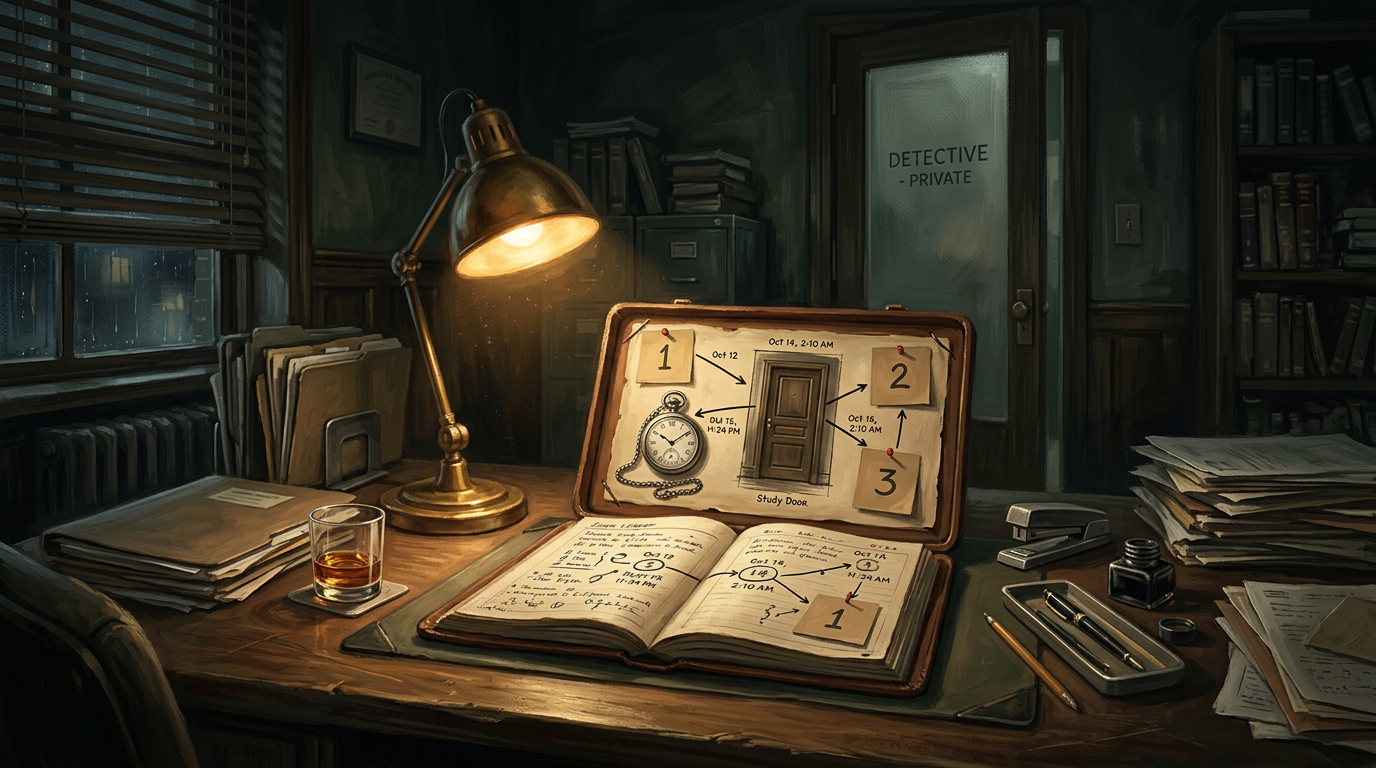
For a fictional murder mystery, the reliable way to find the answer is to separate confirmed clues from claims, build a timeline, and test each suspect’s story against the evidence. Keep your leading theory provisional until it explains the important facts better than the alternatives.
Key takeaways
- Record what you know, where it came from, and what is still uncertain.
- Build a timeline before settling on a suspect.
- Treat contradictions as leads to investigate, not proof of guilt.
- Test the strongest alternative explanation before making an accusation.
- If you mean a real-world murder, contact emergency services or law enforcement; do not investigate it yourself.
How to solve a murder mystery step by step
A fictional mystery can feel like a room full of raised eyebrows and locked doors. The practical task is more orderly: collect information, sort it, test statements, and decide whether the evidence supports one explanation.
1. Read the rules and establish the limits
Start by learning what the story or game tells you about the case. Note the known time window, location, people involved, and any explicit rules about how evidence works. Do not quietly add facts that the mystery has not supplied. If a detail is missing, mark it as unknown rather than filling the gap with a convenient guess.
2. Make a case ledger
Create a simple list or table. For each clue, record its source and status. A timestamp in a log is not the same kind of information as a suspect’s recollection; both may matter, but one is a record and the other is a claim that needs checking.
| Item | What it establishes | Status | What to check next |
|---|---|---|---|
| A time-stamped entry | Something was recorded at a particular time | Confirmed record, subject to the story’s rules | Who made the entry, and what does it actually show? |
| A suspect’s statement | What the suspect says happened | Claim | Can another clue support or contradict it? |
| A personal object | A possible connection to a place or event | Unclear until contextualized | Could it have been moved, borrowed, or left earlier? |
This habit prevents a common error: treating every clue as if it were a verdict. A useful case-file guide also recommends recording timestamps and sources before interpreting them (case-file mystery guide).
3. Build the timeline
Write the important events in order, including the earliest and latest possible time of the crime if the story gives them. Add each suspect’s claimed whereabouts and the time of every relevant record. Leave gaps visible. A gap is not evidence that someone was committing the crime; it is simply a question the case has not answered yet.
4. Test each alibi
For every alibi, ask three things: Does the timing fit? Is there independent support? Could the suspect have left and returned without the account noticing? Compare the claim with records and other statements. A person may be mistaken about a time, protecting someone else, or concealing an unrelated secret. The inconsistency needs an explanation before it becomes meaningful.
5. Compare explanations, then decide
Develop more than one plausible account of events. Check which facts each account explains and which facts it leaves behind. The strongest solution should fit the key evidence without depending on a chain of unsupported assumptions. Only then consider whether the case gives you enough to make an accusation.
How do you weigh clues, alibis, and motive?
Not every clue has the same weight. A useful distinction is between what a clue directly establishes and what you infer from it. A door record may show that a door opened at a certain time; it does not, by itself, prove who entered or why. A suspect’s nervous manner may be memorable, but it does not establish an event at all.
Separate fact from interpretation
Write a clue in neutral language before drawing conclusions. For example: “The ledger shows an entry at 9:14” is more precise than “The suspect sneaked into the room at 9:14.” The first describes the record; the second adds a person, an action, and an intention that may not be proven.
Then ask what would make the clue stronger or weaker. Is the record reliable within the story? Does it identify a person, or only a location? Could it have been created earlier, altered, or misunderstood? In a game, use the rules and information provided rather than importing assumptions from real life.
Treat motive as context, not a shortcut
Motive can help explain why a suspect might act, but it does not prove that they did. Opportunity matters too: could the person have been at the relevant place during the relevant time? Neither motive nor opportunity should outrank direct, reliable evidence. A compelling motive attached to a weak timeline is still a weak solution.
| Question | What it can help establish | What it cannot prove alone |
|---|---|---|
| Did the suspect have a reason? | Possible motive or context | That they committed the crime |
| Could they reach the scene in time? | Opportunity | That they were there |
| Does a record place them there? | A possible connection to the scene | What they did once there |
| Does a statement conflict with a record? | A question worth pursuing | Guilt or the reason for the lie |
A contradiction is a lead, not an automatic conviction. Another mystery-game guide similarly advises tracking what is confirmed, what is claimed, and what remains unanswered (evidence-led mystery guide).
What should you ask suspects?
Begin with open questions that let each person give an account in their own order. “What did you do between nine and ten?” is more useful at first than “Why were you in the study at 9:14?” The second question assumes a fact you may not have established and invites a defensive answer before you have heard the story.
Follow up with specific, neutral questions:
- “What time did you arrive, and how do you know?”
- “Who else was there?”
- “What happened immediately before and after that?”
- “Can you explain how this record fits your account?”
- “Is there another reason this detail might be wrong?”
Keep questions tied to evidence. If a statement conflicts with a timestamp, name the record and ask about the difference. Do not confuse confidence, charm, irritation, or an awkward pause with proof. In a fictional game, the point is to compare accounts with available clues, not to diagnose a suspect from their manner. A guide to playing murder-mystery games also describes asking about whereabouts and comparing answers with evidence and other accounts (how to play a murder mystery).
A small fictional example: what does the timeline prove?
Here is an original, self-contained puzzle. Every fact needed to solve it appears below. No knowledge of a particular game or real investigation is required.
At Bell House, the host, Mr. Vale, is found dead in the study at 9:30 p.m. The case states that the fatal event happened between 9:10 and 9:20, and that whoever caused it had to enter the study during that window. Three guests are being considered: Ada, Bram, and Cora.
The case file provides these clues:
- Ada says she was in the dining room from 9:00 to 9:25. A dining-room photograph, taken at 9:12 and 9:18, shows her in the room both times. The housekeeper confirms that Ada remained there between those photographs.
- Bram says he was in the front hall from 9:05 to 9:25. A continuous security recording shows him in the hall throughout that period. The recording also shows that the hall has no exit to the study.
- Cora says she was in the conservatory from 9:00 to 9:25 and did not enter the study. A conservatory clock is known to be seven minutes fast. Its photograph shows Cora there when it reads 9:19. A separate, synchronized hall clock is visible in the same photograph and reads 9:12.
- The study door log records one entry during the fatal window, at 9:15. The case states that the log is accurate, that it records the person entering, and that no one else entered the study during that window.
Pause here if you want to solve it yourself. Start with what the timeline establishes, not with who seems most suspicious. Does the conservatory photograph prove Cora was there at 9:19, or does the second clock change the time? Is the door log merely suggestive, or does the case tell you exactly what it records?
Common mistakes that lead to the wrong accusation
Choosing a suspect first. Once you decide who “looks guilty,” it is tempting to make every clue support that idea. Instead, write down what would disprove your preferred theory. A useful method is to ask: if this suspect were innocent, what would I expect to find?
Treating a lie as proof of murder. People in mysteries may lie to hide embarrassment, protect another person, or conceal an unrelated matter. A lie can matter, but you need to connect it to the crime through timing, evidence, or another reliable fact.
Forgetting that clocks and records need context. A timestamp is useful only if you know what the clock measures and whether it is accurate. As the example shows, a fast clock can make a sound alibi look stronger than it is. Check the case’s stated rules before interpreting a time.
Overvaluing motive. A dramatic dispute may create a strong story, but stories are not proof. Compare motive with opportunity and evidence rather than letting it replace them.
Ignoring the alternative. If two explanations fit the facts, identify what would distinguish them. Do not force certainty where the evidence remains incomplete. A guide on avoiding premature accusations recommends testing innocent explanations for suspicious behaviour (alternative-theory guide).
When are you ready to make an accusation?
You are ready when your explanation fits the key clues, survives a check against the timeline, and is stronger than the plausible alternatives. Before you commit, summarize the case in a few sentences: who had the relevant opportunity, what evidence supports that conclusion, and what apparent contradiction has been resolved. If the summary relies on “they seemed nervous” or “they had a reason,” return to the evidence.
For a low-pressure way to practise fictional deduction, CaseZero’s free case, #0001 The Last Guest, is available with no account required. Its public teaser asks: “Six people sat down to dinner. Five of them lied about it.” That is a good reminder to separate a lie from proof of the central crime.
If you want another option, Case Pack 01 costs €12.99 and includes The Silent Floor, Dead Letter, and The Second Key. You can also browse the CaseZero cases page. These are fictional detective-game options, not instructions for investigating real crimes.
Fictional deduction is not real-world investigation
This guide is about reading, playing, or hosting a fictional mystery. If you are concerned about a real death or immediate danger, contact emergency services or law enforcement. Do not question people, search a scene, or try to gather evidence yourself. Real investigations have serious safety and legal implications that a puzzle-solving checklist cannot address.
For a fictional case, the discipline is simpler: record the clues, build the timeline, test the claims, and keep alternatives alive until the evidence narrows them. That is how you trade a hunch for a reasoned answer—and avoid mistaking the loudest suspicion for the truth.
Solution
Cora is the only suspect who could have entered the study during the fatal window. The conservatory clock reads 9:19 in the photograph, but the synchronized hall clock reads 9:12. Because the conservatory clock is seven minutes fast, the photograph was taken at 9:12, not 9:19. It proves Cora was in the conservatory at 9:12; it does not place her there for the rest of the window. The accurate study log records an entry at 9:15 and, by the case’s stated rules, identifies the person entering. Ada is accounted for in the dining room, and Bram is continuously recorded in a hall with no route to the study. The log therefore identifies Cora as the person who entered during the window. Her claim that she did not enter conflicts with the decisive record. The solution follows from the timeline and the explicit rules—not from the mere fact that she lied.
This video is hosted by YouTube. Loading it shares your IP address with Google and may set cookies.
Questions from the squad room
How do you solve a murder mystery step by step?
Record each clue and its source, separate facts from interpretations, and build a timeline. Compare suspects’ statements with records and with one another. Keep more than one theory open until you can explain the important evidence and rule out plausible alternatives. Make an accusation only when the evidence supports it better than the competing explanations.
How can I tell whether a suspect’s alibi holds up?
Check whether the timing is possible, whether independent evidence supports the account, and whether the suspect could have left and returned unnoticed. Confirm what a timestamp actually measures and whether the story says the record is reliable. A gap or inconsistency invites a follow-up; it does not establish guilt by itself.
Should I focus on motive or opportunity first?
Start with the timeline and opportunity, because they help establish who could have been involved and when. Consider motive as context, not proof. A person may have a compelling reason but no demonstrated opportunity; another may have had access without being responsible. The strongest conclusion fits motive, opportunity, and evidence without relying on any one factor alone.
Does a contradiction mean someone is guilty?
No. A contradiction means two pieces of information do not currently fit. The difference could come from a mistaken memory, an inaccurate clock, a misunderstanding, or a lie about something unrelated. Check the source and significance of the conflict, then look for evidence connecting it to the crime before drawing a conclusion.
What should I ask suspects in a fictional mystery?
Begin with open questions about where they were, what they saw, and what happened next. Then follow up with specific questions tied to a clue or timestamp. Ask how they know a time and whether someone can confirm it. Keep your wording neutral; a useful question tests an account rather than assuming the suspect is guilty.
What should I do if I mean a real murder rather than a game?
If there is immediate danger or a real death, contact emergency services or law enforcement. Do not question potential witnesses, search a location, or attempt to collect evidence yourself. This guide is for fictional mysteries; real-world situations require trained authorities and may involve safety and legal considerations.
More from the Casebook
 Detective guides · 02 Nov 2026 · 9 min
Questions to Ask a Murder Suspect
Questions to ask a murder suspect in a detective game, with a fair sequence for alibis, timelines, evidence and contradictions—without spoilers.
Read the file Mystery games · 02 Nov 2026 · 10 min
Free Murder Mystery Games Online: 5 Worth Trying
Compare five free murder mystery games online, from daily deduction puzzles to full case files, and find the right browser mystery for your evening.
Read the file Mystery games · 02 Nov 2026 · 8 min
Hunt a Killer Alternatives: 5 Ways to Play
Hunt a Killer alternatives compared by format, price and commitment. Find a physical case file, browser mystery or free case to try first.
Read the file