How to Spot Contradictions in Witness Statements
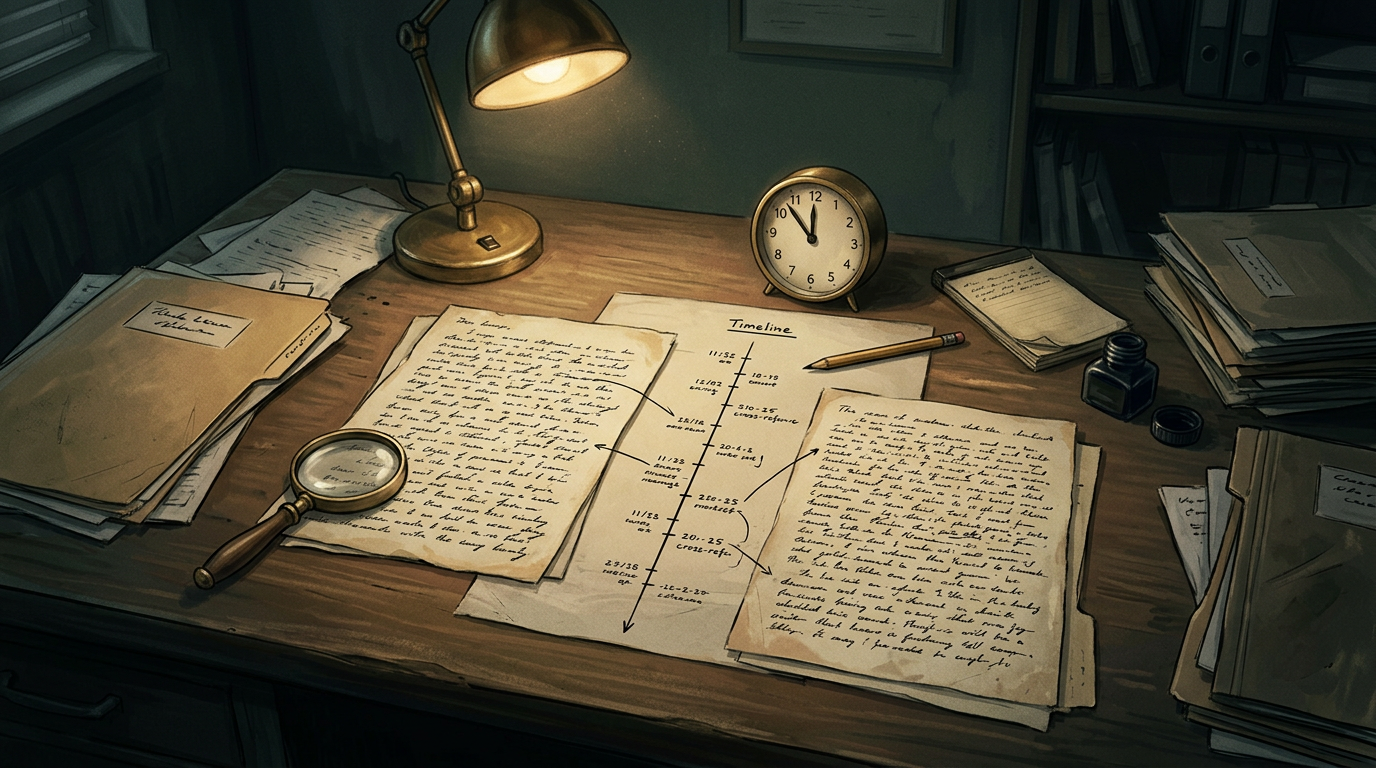
To spot contradictions in witness statements, extract specific claims, compare them event by event, and check the original wording and context. Treat a clash as a lead to investigate—not automatic proof that someone is lying.
Key takeaways
- Separate direct contradictions from omissions, uncertainty, and differences in perspective.
- Compare who, what, when, and where before judging whether a conflict matters.
- Build a timeline and record the source of each claim.
- Look for alternative explanations and verify details where possible.
- Ask neutral follow-up questions; do not treat one inconsistency as proof that an entire account is unreliable.
What counts as a contradiction in a witness statement?
A contradiction occurs when two claims about the same event cannot both be true as stated. For example, one person says a door was open at 8:10, while another says that same door remained closed throughout the period that includes 8:10. First confirm that the accounts refer to the same door, time, and event. Otherwise, the apparent clash may be a mismatch in wording or scope.
Not every difference is a contradiction. One witness may say a room was “busy” and another may call it “crowded.” Those descriptions can coexist. A witness who does not mention a detail has not necessarily denied it either. That is an omission, not a direct conflict.
It helps to sort observations into four categories:
| Type of difference | What it means | Example |
|---|---|---|
| Direct contradiction | Two claims cannot both be true in the stated circumstances | “The door stayed shut” versus “The door opened at 8:10” |
| Difference in perspective | Accounts describe the event from different positions or viewpoints | One witness saw a person enter; another, facing away, did not |
| Omission | A detail appears in one account but not another | One statement mentions a coat; the other says nothing about clothing |
| Uncertainty or hearsay | The speaker is unsure, or reports what someone else said | “I think it was around eight” or “A neighbour told me” |
Check whether a discrepancy concerns a central fact or a minor one. A disagreement about the order of key events may warrant careful follow-up; a difference in an incidental description may have little bearing on the account. Even then, importance depends on context, not on how dramatic the detail sounds.
The National Institute of Justice guide distinguishes checking a statement internally from comparing it with other statements or evidence. The useful discipline is to assess each conflict specifically: one inconsistency does not, by itself, invalidate everything else a person said.
How to spot contradictions in witness statements: a six-step method
Use the same process for each account. Keep the notes factual and leave room for more than one explanation.
1. Preserve the original wording
Start with the statement as recorded, not a summary from memory. Copy the relevant sentence and note where it appears, who recorded it, and when. If an interview was summarized, check whether you can access the original wording or ask how the summary was made. “I saw him at eight” can mean a precise time, an estimate, or a shorthand recollection; a paraphrase may hide that distinction.
Do not silently tidy away hesitations or qualifications. Phrases such as “I think,” “about,” and “as far as I could tell” affect how certain a claim is. If an account changed between versions, place both versions side by side before describing the change. Context can matter: guidance on comparing witness statements recommends checking original wording and related records rather than relying on a compressed retelling.
2. Break the account into checkable claims
Separate the narrative into individual claims about who, what, when, and where. Avoid broad labels such as “the witness’s story is inconsistent.” Instead, write: “The witness places the meeting before the alarm” or “The witness says they were in the lobby at 8:12.” A claim should be specific enough that another person could understand what would support or challenge it.
Mark whether each point is something the witness says they saw or heard, an inference they drew, or information they got from someone else. “I heard a crash” is a reported perception. “Someone must have dropped a tray” is an interpretation. “My colleague said a tray fell” is second-hand information. Those are different kinds of claims and should not be compared as though they were interchangeable.
3. Compare like with like
Pair statements about the same event and the same time window. Check whether the speakers mean the same person, place, object, and action. One account may describe when someone arrived; another may describe when they were noticed. Those times can differ without either witness being wrong.
If a detail is unclear, mark it as unclear rather than filling in the gap. Ask whether “the entrance” refers to the main door or a side entrance, and whether “after lunch” means immediately afterward or later in the afternoon. Comparisons become reliable only when the claims have matching scope.
4. Build an event-by-event timeline
Put the claims in chronological order, including estimates and ranges. Use question marks where a time is uncertain; do not force approximate recollections into exact slots. Then look for overlaps, gaps, and sequences that appear impossible. A chronology can expose a conflict about when someone arrived, where they were, or whether one event could have happened before another.
The International Protocol on the Documentation and Investigation of Sexual Violence in Conflict identifies chronology, location, participants, and sequence as useful areas to examine. Its procedural guidance supports a simple habit: record what an account says about each event, rather than relying on a general impression that it “doesn’t add up.”
5. Check the context and other records
Ask what the person could see, hear, or know from their position. Consider lighting, distance, noise, interruptions, and whether the witness was estimating the time. Then compare the claim with available records or physical evidence, such as a dated message, a log, or a map. Note what each item can establish and what it cannot. A record might show when a door was used, for example, without identifying who noticed it.
Keep evidence separate from interpretation. Write down the record or observation first, then explain how it relates to the claim. If an account seems inconsistent with a document, check that both concern the same date, clock, location, and event. A mismatch could reflect a faulty time setting, an incomplete record, or a mistaken recollection—not necessarily deliberate deception.
6. Record the conflict and ask a neutral follow-up
Describe the exact pair of claims, why they appear incompatible, and what remains uncertain. Then ask an open question that gives the witness room to explain: “Can you walk me through what you remember about the entrance between eight and half past?” Avoid questions that smuggle in an answer, such as “Why did you say the door was closed when it was clearly open?”
The follow-up is not a verdict. The protocol guidance cautions against treating differences as automatic proof of dishonesty or unreliability. Seek an explanation and, where possible, verify the underlying facts. For real legal matters, this is general analytical guidance, not jurisdiction-specific legal advice; consult a qualified legal professional about your situation.
How should you compare two statements?
A comparison table stops a strong impression from outrunning the source material. Use one row per claim or event. Do not blend several statements into one paraphrase, and do not describe an inconsistency as intentional unless there is separate evidence for that conclusion.
| Claim or event | Source and wording | Time and place | Apparent conflict | Alternative explanation | Follow-up or check |
|---|---|---|---|---|---|
| Door opened | Statement A: “The front door opened around 8:12.” | Lobby, about 8:12 | Statement B says it stayed shut until 8:20 | Different time estimate or mistaken recollection | Check original wording; ask how the time was estimated |
| Witness’s position | Statement B: “I was at reception.” | Reception desk, 8:00–8:20 | Does not alone show what the witness could see | View may have been obstructed or attention elsewhere | Ask about sightline and activity |
A useful working record includes the claim, its source, time and location, the other claim it conflicts with, possible explanations, and the next check. Add a confidence note only if you can explain its basis. “The statement is vague about the time” is more useful than “the witness seems unreliable.”
The method in this practical guide to extracting and comparing claims likewise focuses on lining up specific claims event by event. The key is not the table itself; it is the restraint it enforces. Every conclusion should be traceable to wording, context, or a checkable record.
Worked example: is this a real contradiction?
Read the two short accounts before looking at the analysis. Assume both refer to the same building, the same front door, and the period from 8:00 to 8:20.
- Statement A: “I was in the lobby. At about 8:12, I saw the front door open and a courier enter.”
- Statement B: “I was at reception from 8:00 until 8:20. The front door stayed shut the whole time.”
The claims seem to clash: the door cannot both have opened at about 8:12 and stayed shut throughout the period. But first notice what the accounts do not establish. They do not tell us whether either person had an accurate clock, whether “about 8:12” is a close estimate, or whether a brief interruption affected what someone noticed. Nor do they establish why the accounts differ.
A careful note would identify the conflict as a disagreement about the front door’s state during an overlapping time window. It would preserve both original sentences, mark the time as approximate in Statement A, and list follow-up checks: clarify how each person estimated the time, ask about their view and attention, and look for records that might independently confirm door use. The question is what happened and what can be checked—not which person to label a liar.
What should you do when you find a possible contradiction?
Pause before resolving it. Re-read the full passage around each claim, then check whether you have mistaken an estimate for an exact time or a failure to mention something for a denial. If the accounts are from different occasions, note that too; wording can shift with context, and a later statement may clarify rather than simply reverse an earlier one.
Next, separate the conflict from its importance. Ask what conclusion would change if one claim were accurate rather than the other. A disagreement about a central event may deserve more attention than a difference about an incidental detail, but importance is not proof. The model jury instructions provide a useful general reminder to consider the importance of a fact and whether innocent error could explain a discrepancy. They are not a universal legal standard, so do not treat them as jurisdiction-specific advice.
Finally, log what you know, what you do not know, and what could clarify the point. Use neutral wording: “Accounts differ on whether the entrance opened during this interval.” Avoid recording “Witness B lied” unless that conclusion has been established through an appropriate process. In formal investigations, preserve source documents and follow the relevant professional and legal procedures.
Put the method into practice
The same habits are useful in a detective puzzle: pull out claims, compare them with the available evidence, and keep a timeline. That is a low-stakes way to practise careful reading, not professional investigative training. CaseZero’s free case #0001 The Last Guest is available with no account required. For more browser-based case work, Case Pack 01 includes The Silent Floor, Dead Letter, and The Second Key for €12.99. The public teaser reads: “Six people sat down to dinner. Five of them lied about it.” No need to decide what that means before examining the evidence.
For another practical approach to weighing clues and keeping a case organized, see this guide on how to solve a murder mystery. When you return to real statements, keep the same boundary: contradictions suggest questions to ask and facts to verify. They do not, by themselves, tell you who is truthful.
Solution
In the worked example, there is a direct contradiction about one event: Statement A says the front door opened at about 8:12, while Statement B says it stayed shut for the entire overlapping period, 8:00–8:20. Those claims cannot both be accurate as written, assuming they refer to the same door and time window. The fair conclusion is limited to that conflict. The statements alone do not prove which account is correct, whether either person was mistaken, or whether anyone intended to mislead.
This video is hosted by YouTube. Loading it shares your IP address with Google and may set cookies.
Questions from the squad room
What counts as a real contradiction in a witness statement?
A real contradiction is a pair of claims about the same event, time, place, and subject that cannot both be true as stated. Before calling it a contradiction, check that the accounts use the same terms and time window. An omission, uncertain estimate, or difference in viewpoint may be relevant, but it is not automatically a direct conflict.
Does a contradiction prove that a witness is lying?
No. A discrepancy can result from memory, imprecise wording, different viewpoints, or an innocent mistake. It is a reason to ask a focused follow-up question and check the underlying facts. Record the specific claims and the evidence supporting any conclusion; do not treat one inconsistent detail as proof that the whole account is false.
How do I find timeline contradictions?
Extract every time-related claim, preserve whether it is exact or approximate, and place the events in chronological order. Note overlapping periods, gaps, and sequences that appear impossible. Then check whether the witnesses mean the same event and use the same time reference. Keep uncertain times marked as uncertain rather than forcing them into precise slots.
How should I compare two witness statements?
Compare specific claims rather than summaries of each person’s overall story. For every claim, record its wording, source, time, place, apparent conflict, possible explanations, and next check. Read the surrounding context, distinguish direct observation from inference or hearsay, and use neutral follow-up questions to clarify details.
What should I do if a statement conflicts with a document?
Confirm that the document and statement concern the same date, time zone or clock, location, and event. Record exactly what the document establishes and what it does not. A record may provide useful context without settling who saw or did something. For an actual legal matter, seek advice from a qualified professional in your jurisdiction.
More from the Casebook
 Detective guides · 22 Nov 2026 · 10 min
How to Build a Murder Investigation Timeline
Learn how to build a murder investigation timeline with traceable sources, honest time ranges, and a practical template for finding gaps and conflicts.
Read the file Detective guides · 19 Nov 2026 · 10 min
Crime Scene Evidence Checklist: A Practical Guide
Use this crime scene evidence checklist to understand what to document, what evidence may matter, and why safe handling and clear records count.
Read the file Detective guides · 17 Nov 2026 · 11 min
How to Solve a Murder Mystery Puzzle: A Practical Method
Learn how to solve a murder mystery puzzle with a clear method for sorting clues, checking alibis, building a timeline and making a fair accusation.
Read the file