How to Build a Murder Investigation Timeline
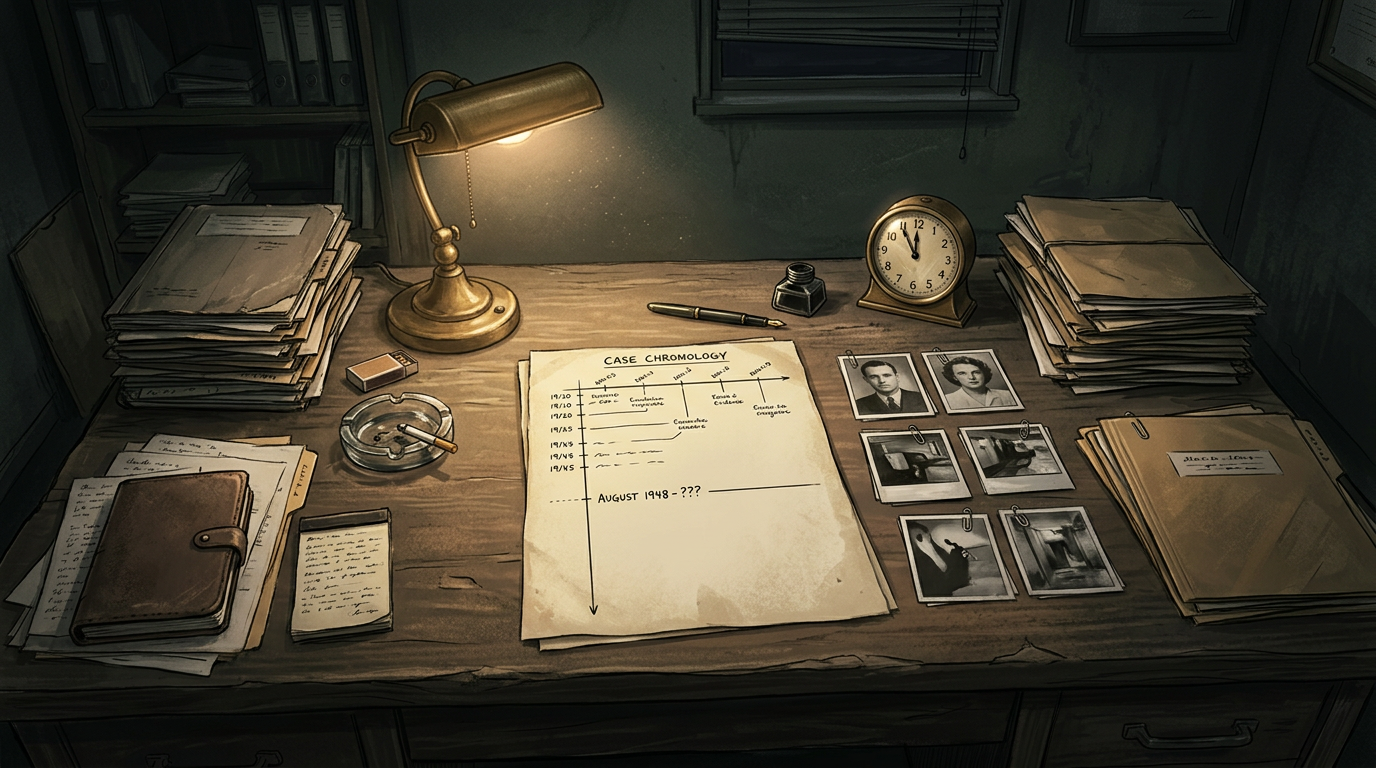
A murder investigation timeline puts relevant events in order so you can see what is known, what is disputed, and where time remains unaccounted for. To build one, log each event with its time or range, source, and confidence level—then update the chronology when new information changes it.
Key takeaways
- Record facts and accounts separately from your interpretations.
- Preserve approximate and disputed times; do not make them look exact.
- Give every entry a traceable source and a clear confidence label.
- Compare people’s accounts against one another and against records, without treating a discrepancy as proof of guilt.
- Keep the incident chronology separate from later investigative events when that makes the record clearer.
How to build a murder investigation timeline
The method below is designed for organizing a fictional case, a mystery game, or research notes. It is not professional investigative training. In a real case, leave evidence handling and investigative decisions to the appropriate authorities.
1. Define the period and purpose
Start by deciding what the timeline needs to explain. An incident timeline covers the events before, during, and after the death, including when the person was last seen and when they were discovered. An investigation timeline covers later actions such as interviews, reports, and procedural events. These can be kept in separate sections or documents so that the incident chronology does not disappear beneath later paperwork.
Set a reasonable time window. Begin before the earliest relevant event and end after the discovery or another clear boundary. You can widen it later if new information makes an earlier event relevant. Write down the question you are trying to answer, such as: “Where was each person between the last confirmed sighting and discovery?”
2. Gather and label the source material
Collect the available material before arranging it: witness statements, movement records, communications, documents, CCTV, photographs, and other records. The Minnesota Protocol guide describes drawing on sources including statements, movements, communications, documents, phone-site data, financial transactions, CCTV, photographs, and lifestyle data. For a fictional case, use only material provided by the story or game.
Give each source a short identifier, such as W1 for a witness account or R2 for a record. Note where the relevant detail appears: a page, timestamp, file name, or scene. This makes it possible to check an entry instead of relying on memory. Guidance on criminal-case chronologies likewise recommends recording source identifiers and where information appears (Justik’s timeline guide).
Do not silently combine different sources into a single “fact.” If one person says an event happened at 8:10 and a digital record is stamped 8:14, enter both claims separately until you know whether they refer to the same event and clock.
3. Create a simple, traceable table
A spreadsheet, notebook, or digital document is enough. Use one row per event or claim, with columns that let you distinguish the event from the strength of its support.
| Date and time (or range) | Event or claim | Person / place | Source | Confidence or status | Notes / follow-up |
|---|---|---|---|---|---|
| 19:40 (approx.) | Says they arrived | Rowan / east entrance | W1, statement p. 2 | Reported, approximate | Check against entry record |
| 19:47 | Entry recorded | Rowan / east entrance | R1, visitor log | Recorded, time shown | Clock accuracy not established |
| 20:05–20:25 | Says they remained in archive | Mara / archive | W2, interview p. 1 | Reported, disputed | Compare with other records |
Adapt the labels to the material. Useful options include recorded, reported, approximate, disputed, and unknown. These are not verdicts. They describe the current state of the information. A source can be clear about what it records while the meaning or accuracy of that record remains uncertain.
4. Put events in order without forcing precision
Sort entries by time, but keep ranges visible. If a witness remembers an event as “around eight,” record an approximate time or range rather than assigning an exact minute. If two accounts place an event at different times, preserve both claims and mark the conflict. Do not choose one merely because it makes the sequence neater.
When the time itself is uncertain, say so. “Between 8:00 and 8:20, according to W2” is more useful than “8:10” if the source never gave that precision. If clocks may differ, note that too. A chronology is a working model, not a polished narrative; uncertainty belongs in the record.
5. Compare accounts and identify gaps
Make separate passes through the timeline for each person. Ask where each person says they were, what they say they saw or heard, and which source supports or challenges that account. Then compare these tracks with the victim’s last known sighting, significant conversations, and any available movement records. An evidence-board approach commonly keeps attention on locations, last known sightings, and significant conversations (DNCIS’s evidence-board overview).
Look for three things: gaps, where no information covers a period; overlaps, where accounts place people together or in the same place; and conflicts, where accounts cannot both be accurate as stated. A conflict is a prompt to check the sources and context—not proof that someone is lying. People may estimate time differently, misunderstand a question, or refer to different events.
For each gap, write a specific question rather than filling it with a guess: “No source places Rowan between 8:10 and 8:30.” That keeps an absence visible and gives the next review a useful focus.
6. Separate evidence from interpretation
Use one column for what a source says and another for what you think it may mean. For example: “Camera record shows a person entering the corridor at 20:14” is a source-based description; “Mara was leaving the archive” is an interpretation that may need verification. Keeping these apart prevents a plausible theory from quietly becoming a supposed fact.
A quick comparison can help:
| Entry type | What to write | What to avoid |
|---|---|---|
| Direct record | “Visitor log lists Rowan at 19:47” | “Rowan arrived at exactly 19:47” if the clock is unverified |
| Account | “W1 recalls Rowan arriving around 19:40” | Presenting the estimate as a confirmed time |
| Conflict | “W1 and R1 differ by about seven minutes” | Deciding the discrepancy proves deception |
| Inference | “The sources may refer to different entry points” | Recording a theory as an established event |
This distinction also makes revisions easier. If a source is corrected or reinterpreted, you can update the claim without rebuilding the whole chronology.
7. Review, revise, and keep versions
Revisit the sequence whenever new evidence, a corrected timestamp, or a better understanding of a source changes the picture. The Minnesota Protocol guide says a chronology should be reassessed if evidence calls it into question. Keep a brief change note: what changed, why, and which source prompted the revision.
For a substantial case file, keep the incident chronology distinct from investigative or procedural events. The National Institute of Justice case-file guide lists a chronological record among materials considered for a homicide investigative case file. A dated change log and source references make the chronology easier to review later, whether you are working alone or sharing notes with others.
What should go into a murder investigation timeline?
Include events that help establish sequence, whereabouts, contact, or the development of the case. Depending on what is available, that can mean the victim’s last known sighting, reported movements, arrivals and departures, communications, significant conversations, discovery, and later investigative milestones. The goal is not to list every detail. It is to keep potentially relevant events in a sequence that can be checked.
A compact template is:
Date/time or range:
Event or claim:
Person / location:
Source ID and exact reference:
Status: recorded / reported / approximate / disputed / unknown
Notes or question to check:
Keep the source reference with every entry. The NIJ guide is useful context for why a chronological record belongs in an organized case file; it does not mean a personal or game-solving timeline is an official investigative document.
What if two accounts give different times?
Enter both accounts as separate rows, each attached to its source. Then check whether they describe the same event, whether their times are exact or estimated, and whether the sources may use different clocks or reference points. If the discrepancy remains, label it as disputed and leave it unresolved. A mismatch tells you where to look more carefully; on its own, it does not establish motive, deception, or guilt.
For mystery players, a timeline can turn a crowded set of statements into a manageable comparison. If you want to practise with a fictional case, Case #0001, The Last Guest is free and requires no account. Its public teaser sets the tone: “Six people sat down to dinner. Five of them lied about it.” Keep your notes focused on what the case actually provides; no need to invent the missing minutes.
Timeline or evidence board: which should you use?
A timeline answers when. An evidence board helps you see connections among people, places, objects, and sources. They can work together: use the timeline to order events, then use a board or linked notes to track relationships and questions. Neither should replace the source references that let you check a claim.
| Tool | Best for | Main limitation |
|---|---|---|
| Timeline | Sequence, gaps, overlapping accounts | Can imply false precision if times are not qualified |
| Evidence board | Connections among people, places, and clues | Connections can look stronger than the evidence supports |
| Source log | Finding the original record behind an entry | Does not, by itself, show the overall sequence |
The useful tool is the one that makes uncertainty visible. For a longer browser mystery, Case Pack 01 includes The Silent Floor, Dead Letter, and The Second Key for €12.99. Treat it as a chance to practise careful note-taking, not as a substitute for real investigative training.
Troubleshooting common timeline problems
- Everything is marked “confirmed.” Use more precise labels. A timestamp in a record is not necessarily a verified account of what happened.
- The timeline looks too neat. Restore approximate ranges, competing accounts, and unknown periods. Neatness is not evidence.
- One person has more entries than everyone else. That may reflect more available records, not greater importance. Note the uneven coverage.
- A contradiction seems decisive. Recheck the source wording and context. Record what conflicts and what remains uncertain; do not jump from discrepancy to conclusion.
- New information makes old entries confusing. Keep the original source reference, amend the status, and add a short change note rather than silently overwriting the history.
- The page is becoming a wall of details. Keep the core incident chronology focused and move later investigative milestones into a separate section.
A short practice chronology
Consider this fully fictional exercise. The only supplied clues are: Noor says the person who died was last seen in the dining room at 8:00 p.m.; Mara says she entered the archive at 8:05 and stayed there until 8:25; a hallway camera record shows Mara crossing toward the kitchen at 8:14; Noor reports discovering the death at 8:30. There is no information about the cause, the exact time of death, or anyone’s responsibility.
Enter each statement or record separately. The last-sighting and discovery times are reported by Noor; Mara’s whereabouts are a reported account; and the 8:14 camera entry is a recorded event. The camera entry appears to conflict with Mara’s claim that she remained in the archive throughout the stated period—but the timeline alone does not establish why the accounts differ. That is the disciplined result: a visible question, not a verdict.
Next steps
Start with a blank table, define your time window, and attach a source to every entry. Review the sequence for gaps and conflicting accounts, then update it when the material changes. If you are practising with a fictional mystery, keep the same habits: distinguish a clue from an inference, and let uncertainty remain visible.
Solution
In the practice chronology, Mara’s statement that she stayed in the archive from 8:05 to 8:25 conflicts with the supplied camera record showing her crossing toward the kitchen at 8:14. The supported conclusion is only that the two accounts do not align as stated. The clues do not establish why, what happened to the deceased, or who was responsible.
This video is hosted by YouTube. Loading it shares your IP address with Google and may set cookies.
Questions from the squad room
What should go into a murder investigation timeline?
Include events that clarify sequence, whereabouts, contact, or case development: last known sightings, reported movements, significant conversations, communications, discovery, and relevant investigative milestones. Attach a source to each entry and label whether its time is recorded, reported, approximate, disputed, or unknown. Keep details that do not help the chronology elsewhere.
How do I build a timeline from witness statements and evidence?
Give each source an identifier, record each claim or event as its own entry, and include the exact reference where the information appears. Sort by time while preserving estimates and conflicting accounts. Compare each person’s account with available records, but keep your interpretation separate from what the source actually says.
What if two accounts give different times?
Keep both accounts in separate entries and cite each source. Check whether the times are exact or approximate, whether the accounts refer to the same event, and whether clocks or reference points may differ. If the conflict remains, label it disputed. A discrepancy is a reason to review the material, not proof that someone is lying.
How should I represent an uncertain time or missing period?
Use an honest range, such as “between 8:00 and 8:20,” and identify who or what supports it. For a missing period, write that no source currently places a person or event there. Do not fill gaps with a convenient estimate; keeping uncertainty visible makes the chronology more useful and easier to revise.
Should the timeline include the investigation after the death?
It can, but separating incident events from later investigative or procedural milestones often makes the record clearer. Keep the event chronology focused on the period surrounding the death, then add a second section or timeline for interviews, reports, and other case developments. Preserve source references in both.
What is the difference between a case timeline and an evidence board?
A timeline organizes events by when they happened and helps expose gaps or overlapping accounts. An evidence board helps display relationships among people, places, objects, and clues. They complement each other, but neither replaces a source log: every claim should still lead back to the material that supports it.
More from the Casebook
 Detective guides · 21 Nov 2026 · 10 min
How to Spot Contradictions in Witness Statements
Learn how to spot contradictions in witness statements with a clear comparison method, timeline checks, and neutral follow-up questions.
Read the file Detective guides · 19 Nov 2026 · 10 min
Crime Scene Evidence Checklist: A Practical Guide
Use this crime scene evidence checklist to understand what to document, what evidence may matter, and why safe handling and clear records count.
Read the file Detective guides · 17 Nov 2026 · 11 min
How to Solve a Murder Mystery Puzzle: A Practical Method
Learn how to solve a murder mystery puzzle with a clear method for sorting clues, checking alibis, building a timeline and making a fair accusation.
Read the file