Online Murder Mystery Game for Adults: How to Choose
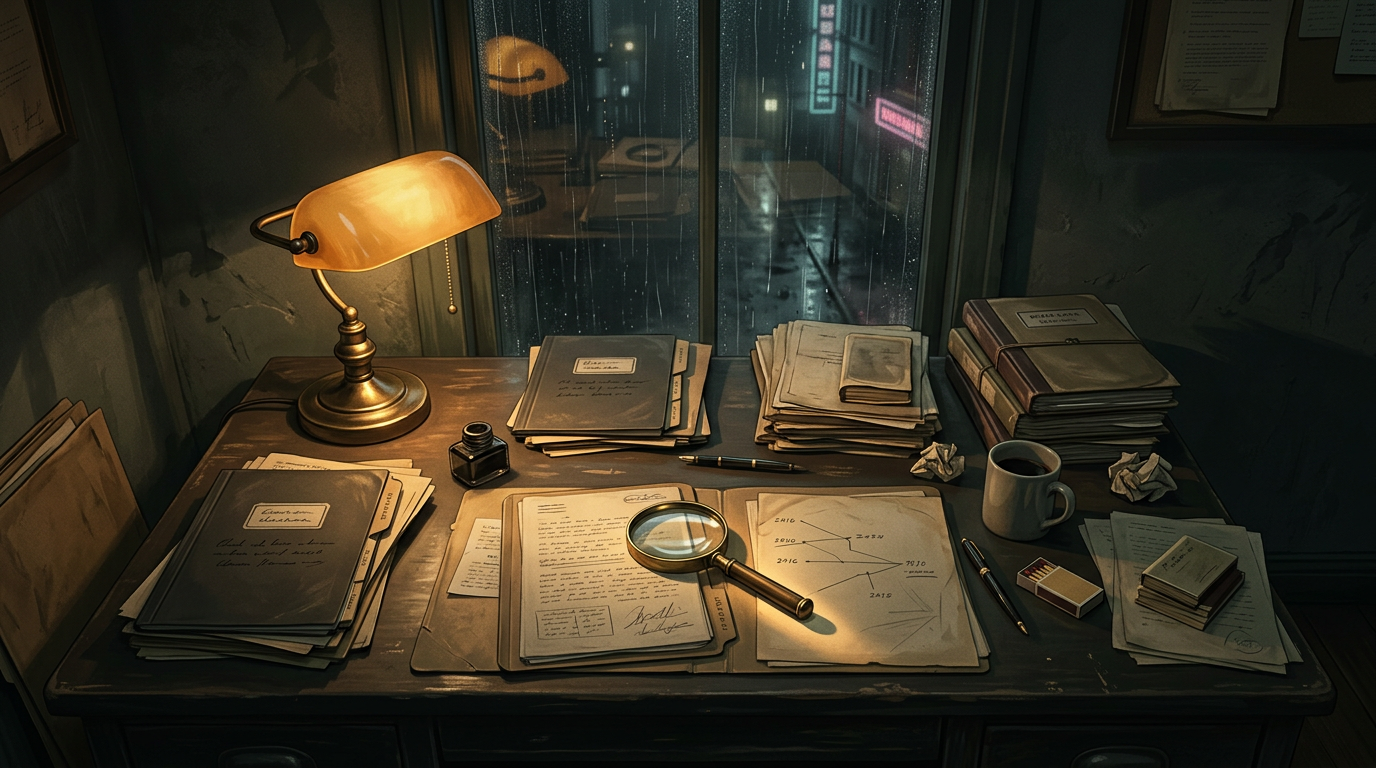
An online murder mystery game for adults is a digital investigation you can play alone, with a partner, or with a group, depending on the game. The best fit depends on whether you want a quick daily puzzle, a shared role-play party, or a longer case built around evidence and deduction.
Key takeaways
- “Online” can mean solo browser play, two-player co-op, or remote group play; check the format before choosing.
- Look at the case length, starting price, account requirements, and whether the game expects you to perform a character.
- A satisfying investigation gives you clues to assess, not just a story to watch unfold.
- CaseZero’s free case, #0001 The Last Guest, is listed as a 30–60-minute investigation with no account or download required to start.
- Start with the free case, then decide whether you want more: Case Pack 01 adds three cases for €12.99.
What is an online murder mystery game for adults?
It is a digital whodunnit in which players gather information and work out what happened. Some games are short, daily puzzles. Others are document-led investigations, live co-op rooms, or party games where players take on assigned roles. “For adults” often signals a taste for layered deduction and a more deliberate pace—not necessarily graphic content or complicated rules.
The first useful question is not “Which game is best?” It is “What kind of evening do I want?” A ten-minute puzzle is a different proposition from a case that asks you to compare statements, revisit clues, and defend an accusation. A role-play party, meanwhile, may depend on several people being available at once.
For a browser-based case to try without an account or download, CaseZero offers #0001 The Last Guest for free. Its listing gives a 30–60-minute playtime and describes five suspects and 14 files. The teaser is concise: “Six people sat down to dinner. Five of them lied about it.” The details stop there until you investigate. That is the point.
Which format suits your group?
“Online” describes where a game runs, not how it is played. Before you buy or invite friends, establish whether everyone can investigate together, whether each person needs a device, and whether the game expects players to act in character.
| Format | Best for | What to check |
|---|---|---|
| Solo browser investigation | Focused, self-paced deduction | Case length, hint system, and whether progress saves |
| Two-player co-op | Comparing interpretations with one partner | Whether both players need accounts or separate devices |
| Remote multiplayer room | Friends in different places | Player limit, room setup, and whether everyone needs to buy access |
| Party role-play | A planned group gathering | Number of roles, host duties, preparation, and performance expectations |
| Daily mystery | A short routine or quick challenge | Whether cases reset daily and how much is included for free |
These are different kinds of entertainment, not rungs on one ladder. A party game can be excellent at creating an occasion and still be a poor choice for someone who wants to read evidence quietly. A solo case can be absorbing but cannot replace the social energy of a group guessing aloud.
For comparison, NOIR advertises co-op for two to six players and offers cases in several length ranges, from 5–15 minutes through to 45 minutes–2 hours. PLAY INQUEST says signed-in players can open a real-time two-player co-op room. Those examples illustrate why “multiplayer” deserves a closer look: player count, room setup, and sign-in requirements vary.
If you are choosing for a group, ask everyone how they want to participate. Do they want to share a screen and reason together, or receive roles and perform? If you are choosing for yourself, check whether the game is designed to make sense solo rather than merely allowing one person to control the group’s session.
How do you choose a good online murder mystery game for adults?
A useful comparison starts with the practical details, then moves to the investigation itself. Check these in order; it saves discovering halfway through that the game is designed for a different kind of night.
1. Confirm the play setup
Look for explicit answers about solo play, co-op, and remote multiplayer. “Play online” does not automatically mean that friends can join from separate locations. A game may be browser-based yet intended for one person or a shared screen. If the listing does not explain how players connect, treat that as an unanswered question rather than assuming.
2. Check the commitment
A daily puzzle and a longer case ask for different amounts of attention. For a quick session, Midnight Casebook describes its daily browser mystery as taking about 10 minutes. CaseZero lists its free first case at 30–60 minutes. Neither length is inherently better; the right one depends on whether you have a spare break or an evening to settle in.
3. Understand the cost and starting friction
Identify what is free, what requires payment, and whether an account or payment details are needed to begin. Do not assume that a free sample includes the whole catalogue. CaseZero’s #0001 The Last Guest is free to start without an account or download, while Case Pack 01 costs €12.99 and includes three additional cases: The Silent Floor, Dead Letter, and The Second Key. The pack is a separate option, not a requirement to try the first case.
For other examples of different access models, Cold Case Online says its first case is free with no sign-up and advertises rooms for up to eight players. Case & Candle describes a free case that asks for an email, alongside paid longer cases. Read each game’s current terms carefully: “free” can refer to a sample, a daily entry, or a larger selection.
4. Look for actual deduction
A strong case gives you information to compare. That might mean documents, statements, messages, or a timeline, depending on the game. The key is not the prop count; it is whether the information helps you test competing explanations. Ask whether you will be making decisions and forming a case, or mainly following a scripted story.
5. Set expectations for tone and accessibility
“For adults” does not have one universal meaning. If you want a classic whodunnit rather than a graphic thriller, check the description and content notes. If you prefer not to perform, find out whether the game assigns characters or expects theatrical participation. Also check language, text size, device requirements, and whether the game works in your preferred browser. Do not infer mature content from the word “adult” alone.
For a more methodical approach to the investigation itself, see this step-by-step guide to solving a murder mystery. It is useful whether the clues arrive as digital files, printed pages, or a daily riddle.
What do you actually do during an investigation?
Most evidence-led games can be approached as a cycle: read, sort, compare, question, and decide. The interface may differ, but a disciplined method helps keep a colourful clue from becoming a conclusion before its time.
A practical five-step method
- Read everything once before deciding. Note names, places, times, and claims. Resist choosing a suspect from a dramatic detail alone.
- Separate facts from statements. A record or timestamp may establish one thing; a person’s account may establish only that they said it. Keep those categories distinct.
- Build a simple timeline. Place events in order and mark gaps or conflicts. A contradiction is a lead to examine, not proof of guilt by itself.
- Ask focused questions. If the game allows you to question a suspect, connect your questions to a specific statement or piece of evidence. Broad prompts often produce broad answers. For more ideas, use this guide to questions to ask a murder suspect.
- Make an accusation only when the evidence supports it. A satisfying explanation should account for the important clues and withstand reasonable alternatives. If your case depends on ignoring a contradiction, it probably needs another pass.
For example, a case file might include a written statement, a time record, and a message. Your job is not to decide that one object “looks suspicious”; it is to ask whether the record supports the statement, whether the message changes the timeline, and what still remains unexplained. This is the difference between collecting clues and using them.
CaseZero presents its free case as a file-based investigation, listing five suspects and 14 files. That gives a prospective player a concrete sense of the material to examine without revealing what any file contains or how the case resolves. If you want to try the format, begin with #0001 The Last Guest. For more after that, Case Pack 01 includes The Silent Floor, Dead Letter, and The Second Key for €12.99.
Online games, party kits, and daily puzzles: what is the difference?
A comparison is easier when the format is made explicit. The labels overlap in search results, but they make different promises about preparation, play time, and company.
| Type | Typical experience | Main advantage | Possible trade-off |
|---|---|---|---|
| Browser investigation | Read clues and reason through a case on a screen | Easy to start; no printing if the game is browser-based | May be designed for individual play rather than a group room |
| Daily mystery | Solve one short puzzle or case in a regular sitting | Low time commitment | Less room for a long, layered investigation |
| Remote co-op | Collaborate through an online room or shared session | Friends can participate from different places | Setup and player limits matter |
| Boxed or printable party kit | Distribute roles and materials for a hosted event | Social, structured group play | May require printing, preparation, and a host |
These are broad categories, not guarantees about every game. A browser game may offer co-op, and a party kit may be playable remotely if its instructions support that. Verify the actual product details rather than shopping by label.
A useful rule: choose a daily mystery when time is scarce; co-op when conversation is the main event; and a document-led case when you want to examine evidence at your own pace. If you are weighing free options, this guide to free murder mystery games online can help you compare formats without treating “free” as a complete description of what is included.
Common mistakes when choosing a game
Assuming online means remote multiplayer. It may mean only that the game runs in a browser. Confirm how people join before arranging a group session.
Choosing by case length alone. A ten-minute game can be satisfying if it offers a neat deduction. A longer case is worthwhile only if you want to spend time reading and comparing details.
Mistaking role-play for investigation. Some murder mysteries assign players characters and rely on performance. Others put everyone on the detective side of the table. Neither is the wrong choice, but they suit different moods.
Taking every suspicious detail as proof. A clue can be relevant without being decisive. Keep track of what is established, what is claimed, and what remains uncertain. The CaseZero case library is the place to check the available case titles and options without relying on plot guesses.
Treating a free case as a promise about the whole catalogue. Check exactly which case is free and what additional cases cost. In CaseZero’s case, #0001 The Last Guest is free to start; Case Pack 01 offers three more cases for €12.99.
Expecting a real crime story. CaseZero is a fictional detective game. Keep the experience in the realm of invented mysteries, where the evidence exists to be examined and no real person’s tragedy is being turned into a pastime.
A simple way to decide
Choose a game by answering three questions: Do you want to play alone or with others? How much time do you have? And would you rather solve a short puzzle or work through a fuller case? Then verify the practical details—account, download, cost, player limit, and content—on the game’s own page.
If a browser-based case sounds right, CaseZero offers #0001 The Last Guest free, with no account or download required to start. Its listed 30–60-minute length makes it a more substantial commitment than a daily ten-minute mystery, while still giving you a clear first step. If you want to continue after that, Case Pack 01 adds The Silent Floor, Dead Letter, and The Second Key for €12.99. Start with the evidence, keep your theories provisional, and let the case earn its conclusion.
This video is hosted by YouTube. Loading it shares your IP address with Google and may set cookies.
Questions from the squad room
Can I play an online murder mystery game alone?
Yes. Some online murder mysteries are built for solo investigation, while others focus on co-op or role-play groups. Check the product page for an explicit player format rather than assuming that browser access means solo play. CaseZero offers #0001 The Last Guest as a free case to start without an account or download.
Do I need to download anything to play CaseZero?
CaseZero lists #0001 The Last Guest as playable without a download and says no account is required to start. The case is free and has a listed playtime of 30–60 minutes. Check the official site for current access details before you begin.
How long does an online murder mystery game take?
It depends on the format. The research notes describe daily browser mysteries at about 10 minutes, while CaseZero lists 30–60 minutes for #0001 The Last Guest. Longer cases and group sessions can take more time, so check the game’s stated length and leave room to compare clues.
Is an online murder mystery game the same as a party game?
Not always. A party game may assign each participant a character and ask them to perform or share information. A detective investigation may instead have players examine evidence and reach a conclusion. Confirm whether the game is solo, co-op, remote multiplayer, or role-play before inviting a group.
What does CaseZero Case Pack 01 include, and how much does it cost?
Case Pack 01 includes three additional CaseZero cases: The Silent Floor, Dead Letter, and The Second Key. The supplied product information lists the pack at €12.99. Case #0001 The Last Guest is a separate free case, so you can try that before deciding whether to get the pack.
More from the Casebook
 Mystery games · 15 Nov 2026 · 8 min
Murder Mystery Games With No Subscription: A Practical Guide
Murder mystery games with no subscription: compare free cases, one-time purchases, formats and practical details before choosing your next investigation.
Read the file Mystery games · 14 Nov 2026 · 9 min
Murder Mystery Game Like an Escape Room: How to Choose and Play
Murder mystery game like an escape room? Compare formats, learn the investigation steps, and find a browser-based case you can try for free.
Read the file Mystery games · 13 Nov 2026 · 9 min
Solo Murder Mystery Game Online: A Practical Guide
Choose a solo murder mystery game online with confidence. Compare formats, learn a fair investigation method and find a browser case to try.
Read the file