Solo Murder Mystery Game Online: A Practical Guide
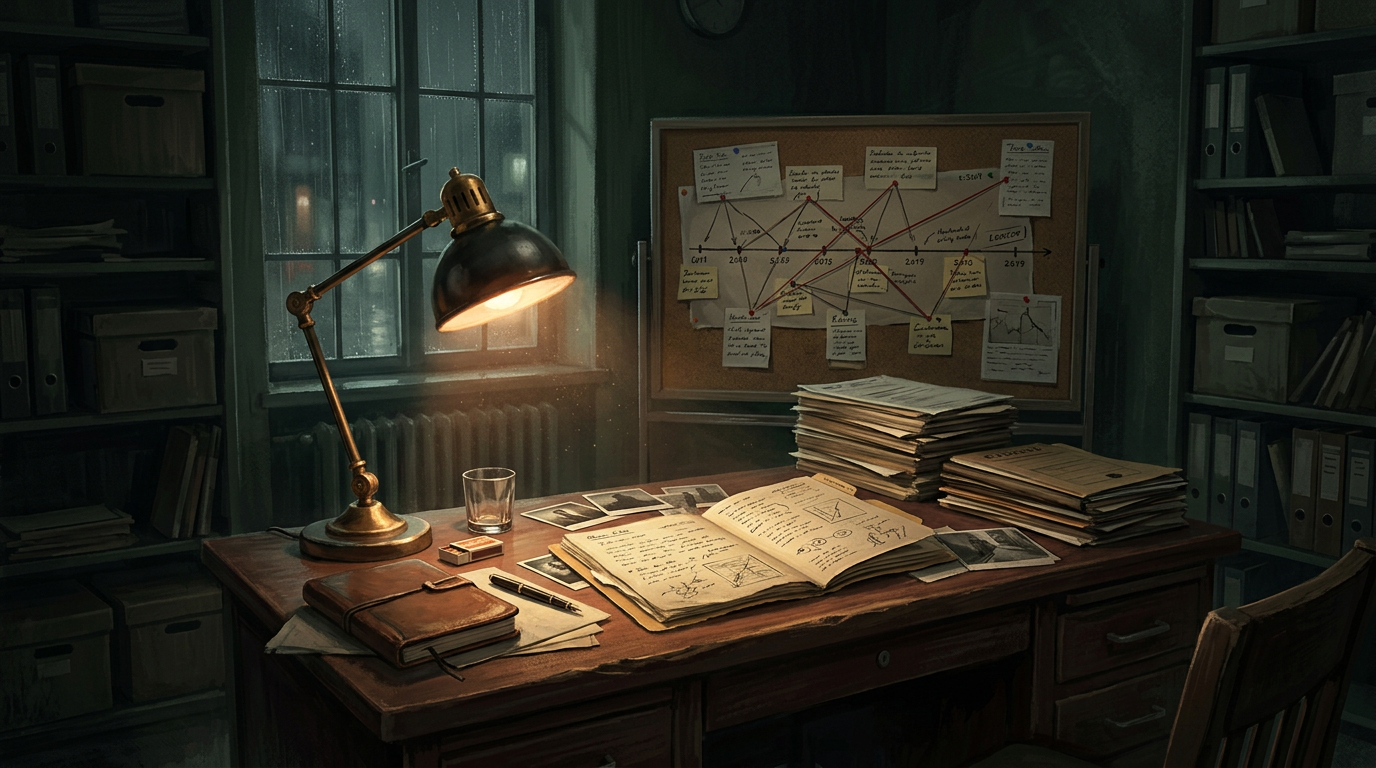
A solo murder mystery game online is a mystery you can investigate by yourself, without a host, cast or group of players. The best fit gives you evidence to examine, a clear way to test your theories and enough information to reach a reasoned conclusion—not just a guess.
Key takeaways
- Check that “solo” means you can play independently, not simply that one person can read a party-game script.
- Look for a stated format, estimated playtime, access requirements and a fair final decision.
- Work from evidence: build a timeline, compare accounts and test explanations before accusing anyone.
- CaseZero’s free case, #0001 The Last Guest, requires no account; Case Pack 01 adds three cases for €12.99.
What is a solo murder mystery game online?
It is a self-guided digital investigation designed for one player. You examine case materials, work out what matters and decide which explanation best fits the facts. Some games present a static case file; others let you question suspects or interact with the evidence. Either way, the central pleasure is doing the reasoning yourself.
That distinction matters. A murder-mystery party kit may be playable by one person in the narrow sense that one person can read every role. But if the experience depends on a host, actors or a group exchanging information, it is not a particularly satisfying solo investigation. A genuine solo game gives you a complete route through the case without requiring someone else to keep it moving.
Online games also vary in how they deliver the mystery. A browser-based case may be ready to open without installing software, while other products may require an account or an emailed access link. “Online” does not automatically mean “instant,” so check the access details before settling in with a notebook and an overconfident theory.
For a concrete example, CaseZero describes #0001 The Last Guest as a free case with no account or download required. Its homepage gives an estimated 30–60 minutes and lists five suspects and 14 files. The teaser is: “Six people sat down to dinner. Five of them lied about it.” That is an invitation to investigate, not a hint about the answer.
Which solo mystery format should you choose?
Start with the kind of detective work you enjoy. Some players like sorting a thick stack of documents; others want to ask suspects questions and see how an account holds up under scrutiny. Neither format is automatically better. The useful question is whether the game gives you enough structure to investigate rather than merely browse.
| Format | What you do | Best suited to | Check before starting |
|---|---|---|---|
| Case-file deduction | Read reports, statements and records; compare details and build a timeline | Players who enjoy close reading and organising evidence | File volume, estimated length and how you submit a conclusion |
| Interactive interrogation | Ask suspects questions and test their answers against evidence | Players who like follow-up questions and conversational investigation | How evidence affects questioning and whether the case has a fixed solution |
| Short guided mystery | Follow a compact set of clues toward a conclusion | A brief break or a first try at solo play | Whether the short format still gives enough information to reason fairly |
The differences are visible in published examples. Cold Case Online describes a free first case with 26 documents and six suspects, while NOIR lists case-length ranges from 5–15 minutes to 45 minutes–2 hours. Those are different products and formats, not a direct quality ranking. They do show why it helps to check the amount of reading and the stated time before you begin.
CaseZero combines evidence review with suspect questioning. Its homepage says players can type questions, confront suspects with documents and make one accusation. The CaseZero case library is the place to check the publicly listed cases and their current details.
How do you investigate a solo case step by step?
A simple process prevents a pile of documents from becoming a pile of unrelated suspicions. Keep notes in plain language. Your first theory may be clever; it is still only a theory until it survives the evidence.
1. Read the case brief before forming a conclusion
Identify the basic questions the game asks you to resolve. Note what is known, what is uncertain and what the final decision requires. Do not fill gaps with familiar detective-story assumptions. If the case has not established a detail, it is not evidence merely because it would make a tidy plot.
2. Make a timeline
Write down relevant events in chronological order. Include times, movements and when a document or object was last confirmed to be in a particular place. Mark uncertain times as uncertain; precision should come from the case, not from your pen.
A timeline helps expose contradictions that are easy to miss when reading statements one at a time. It can also rule out theories that depend on someone being in two places at once or acting before they could know something.
3. Sort facts from claims
A document may record an observed fact, repeat a witness’s statement or contain an interpretation. Those are not interchangeable. Label what is independently confirmed and what comes from a person’s account. Then ask whether another file supports, challenges or simply repeats that account.
4. Compare accounts against the evidence
Look for differences in timing, access, knowledge and wording. A contradiction is a lead, not proof of guilt: people can be mistaken, vague or dishonest for reasons unrelated to the central question. Ask what the inconsistency actually establishes before you build on it.
5. Test more than one explanation
For each plausible theory, write down what it explains and what it fails to explain. A strong answer should fit the important evidence without requiring a string of unsupported assumptions. If a rival explanation accounts for the same facts just as well, you may need to inspect the files again.
6. Make the final decision only when the case asks
Some games let you revise theories throughout; others ask for a final accusation. In a one-accusation format, slow down and check your notes before submitting. CaseZero’s homepage describes a single accusation, so treat it as the end of the investigation rather than a casual button to press while testing a hunch.
For a fuller method, see this step-by-step guide to solving a murder mystery. It is useful whether you are working through a browser game or a printed case file.
How should you question suspects in an interactive game?
Ask specific questions that connect to evidence. “What happened?” invites a broad account. “You said you left before the meeting ended; this record places you there later. How do you explain the difference?” gives you a point to investigate.
A productive sequence is straightforward:
- Ask for an account of the relevant event.
- Note specific claims about time, place, knowledge or contact with evidence.
- Compare those claims with the case materials.
- Follow up on one discrepancy at a time.
- Record what the answer establishes—and what it does not.
A surprising reply is not automatically a breakthrough. Judge it against the complete record, not against how persuasive or suspicious it sounds. CaseZero’s AI disclosure explains an important distinction for its interactive format: AI generates suspect dialogue, while the culprit, motive and method are fixed in the case engine. That means the conversation is a way to investigate a set mystery, not a licence for the answer to change with each question.
If you want more question ideas, this guide to questions to ask a murder suspect focuses on prompts that can uncover useful detail without turning the interview into a fishing expedition.
What are common mistakes in solo investigations?
Treating a lie as proof. A suspect’s false or inconsistent account deserves scrutiny, but it does not by itself establish the full explanation. Ask what the evidence connects to the discrepancy and whether another interpretation remains possible.
Reading every file as equally important. A large file set can tempt you to give every line the same weight. Instead, record what each item contributes: a confirmed time, a disputed claim, a connection between people or an unanswered question.
Confusing sequence with cause. Two events happening close together does not prove one caused the other. Check whether the game gives a link, or whether you have supplied one yourself.
Committing too early. The first coherent theory is often attractive because it gives the details a shape. Keep a second possibility alive until you have checked the timeline and the strongest contradictory evidence.
Assuming a genre convention is a clue. A suspicious manner, a dramatic coincidence or a familiar character type is not a substitute for evidence. Solve the case in front of you, not the one you expect a mystery writer to have written.
Ignoring practical limits. Before starting, check whether the game specifies an estimated duration, account requirement, device support or a way to return to your progress. If a detail is not stated on the product page, do not assume it. For example, look for explicit information about saving, hints and internet access rather than treating those features as standard.
What should you check before choosing a game?
Use this short checklist to avoid buying a format you did not want:
- Solo access: Can you play without a host, other players or a group chat?
- Starting requirements: Is an account, download or email sign-in required?
- Time and volume: Is there an estimated playtime, and does the amount of material sound enjoyable?
- Investigation tools: Can you take notes, revisit files, question suspects or use hints? Check what is explicitly offered.
- Fairness: Does the case provide evidence for its conclusion, rather than asking you to guess a hidden fact?
- Price and scope: Is the free entry case complete, and what exactly does a paid pack include?
For CaseZero, the publicly listed starting point is #0001 The Last Guest, free with no account required. Case Pack 01 costs €12.99 and contains The Silent Floor, Dead Letter and The Second Key. Check the product page for current access and case details before you start; there is no need to infer anything about a case from its title.
As another point of comparison, Cold Case Inc’s solo mystery page describes its free short investigation, Flat 33, as around 10–12 minutes and says access uses an email sign-in link. That is a practical reminder: “free” and “no sign-up” are separate questions. A stated duration is also an estimate, not a stopwatch appointment.
A solo mystery does not need a room full of props to feel involving. It needs a clear question, evidence you can examine and a conclusion you can test. Pick the format that suits your attention span, keep a timeline and let the documents earn your trust one by one. If you would like to try an interactive case in your browser, begin with CaseZero’s free #0001 The Last Guest at playcasezero.com. The files are waiting; the verdict can wait until you have read them.
Solution
Here is a small, independent deduction puzzle to demonstrate how a fair timeline can work. It is not part of a CaseZero case.
An archive ledger is found missing at 8:30. The archivist confirms it was still on the reading-room table at 8:20. The room’s entry log shows Mara left at 8:10, Joel left at 8:20 and Ivo left at 8:30. The log records every person who entered or left during that period, and no one else entered. Who had the last opportunity to remove the ledger?
Answer: Ivo. The ledger was still present at 8:20, so Mara and Joel had already left while it remained on the table. Ivo was the only person still in the room after that confirmation and before the ledger was found missing. The conclusion follows from the stated timeline; it does not depend on a suspicious expression or an invisible clue.
This video is hosted by YouTube. Loading it shares your IP address with Google and may set cookies.
Questions from the squad room
Can I play a solo murder mystery game online completely alone?
Yes. Choose a game designed for one player rather than a party kit that expects a host or cast. A solo format should let you review the evidence, follow the investigation and reach a conclusion without another person managing the experience. Check the product description for any account or group requirements before starting.
Is CaseZero free to play, and do I need an account?
CaseZero’s publicly listed case #0001, *The Last Guest*, is free and requires no account. The homepage also describes it as requiring no download. Case Pack 01 is a separate paid option priced at €12.99 and contains *The Silent Floor*, *Dead Letter* and *The Second Key*.
How long does an online solo mystery take?
It depends on the format and how closely you investigate. CaseZero lists an estimated 30–60 minutes for #0001 *The Last Guest*. Other games publish different ranges, so check the individual case page; treat estimates as guidance rather than a promise that every player will finish in exactly that time.
Can I save my progress or use hints if I get stuck?
Check the specific game’s current information for saving and hint features. Those options are not universal, and they should not be assumed if a product page does not mention them. Before starting, look for explicit details about returning to a case, available guidance and any account requirement.
Are CaseZero’s suspect conversations AI-generated?
CaseZero’s AI disclosure says AI generates suspect dialogue, while the culprit, motive and method are fixed in the case engine. The conversation is therefore part of an investigation with a set solution, rather than a mechanism that changes the case answer based on each question.
More from the Casebook
 Mystery games · 15 Nov 2026 · 8 min
Murder Mystery Games With No Subscription: A Practical Guide
Murder mystery games with no subscription: compare free cases, one-time purchases, formats and practical details before choosing your next investigation.
Read the file Mystery games · 14 Nov 2026 · 9 min
Murder Mystery Game Like an Escape Room: How to Choose and Play
Murder mystery game like an escape room? Compare formats, learn the investigation steps, and find a browser-based case you can try for free.
Read the file Mystery games · 12 Nov 2026 · 9 min
Detective Games to Play in Browser: How to Choose
Detective games to play in browser, compared by play style, cost and case length. Find a no-download mystery that suits your next quiet night in.
Read the file