Murder Mystery Case File Game Online: A Player’s Guide
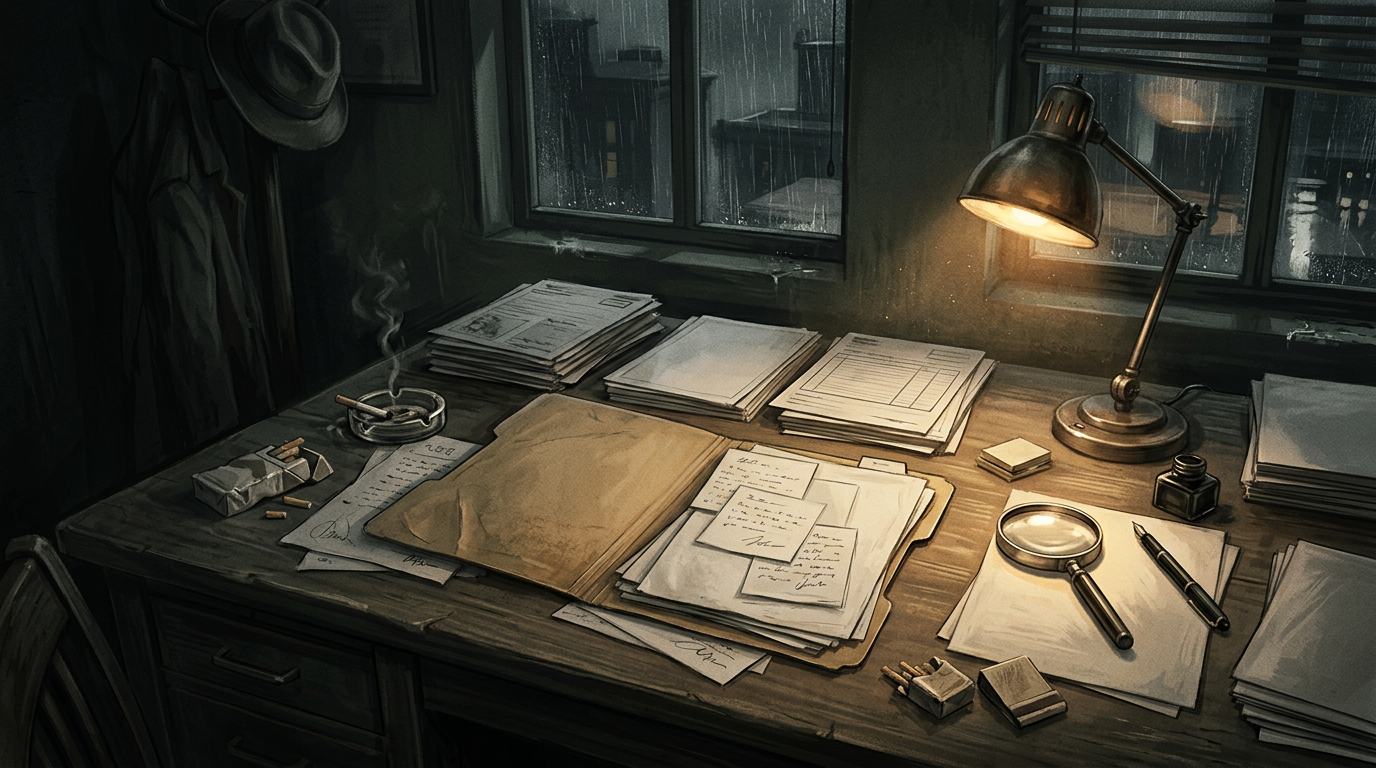
A murder mystery case file game online is a browser-playable investigation where you review evidence, compare accounts and decide what the clues support. It offers the dossier feel of a case file without necessarily requiring a printed kit, a party of players or a download.
Key takeaways
- Check whether the game is a document-led investigation, a party game, a printable kit or a quick logic puzzle; the formats are not interchangeable.
- A satisfying case gives you evidence to compare, a clear way to investigate and a reasoned ending.
- Look for the price, account requirements and number of included cases before you begin.
- Keep a timeline, separate facts from claims and make an accusation only when the evidence holds together.
What is a murder mystery case file game online?
It is a digital detective game built around the act of examining a case. Instead of relying only on a sequence of scenes or a hidden-object search, a case-file format asks you to read materials, assess what people say and connect details across the investigation. The “file” may be presented as a digital dossier, an interactive interface or a set of documents in a browser.
The phrase can describe several different products, though. A printable case kit might ask you to download or print materials. A murder-mystery party game is designed for a group to play characters. A daily logic puzzle may present a small grid or short riddle. A browser investigation, by contrast, lets you work through the case on screen. Search results put all of these under similar labels, so check the actual format before committing.
A good case-file game gives your attention a job. Read the statements, note dates and claims, then ask what each item establishes—and what it does not. A document can make an account more credible, contradict it or simply leave a question open. That distinction is where the detective work begins.
How does a browser case-file investigation work?
The particulars vary by game, but a document-led investigation usually follows a loop like this:
- Read the case materials. Start with the brief and review each document before deciding which details matter. Keep names, times, locations and stated relationships in separate notes.
- Build a timeline. Put events in order using only what the materials support. Mark uncertain times as uncertain; a neat timeline is not automatically a correct one.
- Compare accounts. Look for claims that can be checked against another statement or record. A disagreement is a lead, not proof that someone is lying.
- Ask focused questions. When a game allows suspect questioning, ask about a specific claim or gap. “Where were you at this time?” is easier to evaluate than a broad invitation to tell the whole story.
- Test answers against documents. Return to the file and see whether the answer fits what is recorded. Notice both direct conflicts and details that remain unresolved.
- Make a reasoned decision. When the game asks for an accusation, choose only when you can explain how the evidence supports it. Suspicion is not the same as a case.
For example, if a statement gives a person’s arrival time, check whether another record supports that time before treating it as settled. If an answer conflicts with a document, note the precise conflict. Do not jump from “these accounts differ” to “this proves guilt”; there may be another explanation or an overlooked detail.
CaseZero describes its own loop as reading case documents, questioning suspects in your own words, confronting them with documents and making one accusation. Its homepage also says suspect dialogue may be dynamically generated using AI. That is a reason to treat the conversation as part of the interactive investigation—not a substitute for checking the evidence in the file. See the CaseZero case library for the cases listed there.
How do you choose the right online case-file game?
Start with the experience you want, then compare the practical details. “Online” tells you where the game runs, not whether it is a solo investigation, a shared party activity or a short daily puzzle.
| Format | What you generally do | Check before starting |
|---|---|---|
| Browser case investigation | Read a digital file, examine claims and reach a verdict | Account or download requirements, included cases, price and how the investigation works |
| Printable or boxed case file | Review physical or downloaded materials, often at your own pace | Shipping or printing, number of players and whether the kit includes the full solution |
| Murder-mystery party game | Play characters and share clues as a group | Player count, host requirements and whether it is designed for a single sitting |
| Daily or short logic puzzle | Solve a compact puzzle or deduction challenge | How much narrative and evidence analysis it offers |
Prices and play styles vary. For a point of comparison, PLAY INQUEST advertises a free daily case, browser play and solo or two-player co-op. Midnight Casebook describes cases of about 10 minutes and lists a weekly Pro price. These are examples of different offers, not a universal standard; check each provider’s current page for its own terms.
Before starting, answer four plain questions: Can I begin in my browser? What exactly is included for free? What does paid access add? Is the game meant for solo play, shared play or both? If the page leaves those points murky, the mystery may not be the only thing you are expected to solve.
What makes a case fair—and how should you play it?
A fair mystery lets you reason from the information available, rather than asking you to guess what the writer had in mind. Fairness does not mean every clue is obvious on first reading. It means the important deductions have support in the materials, and that the final explanation can account for the evidence without requiring an unannounced fact.
Use a simple evidence ledger:
| Note type | What to write down | Why it helps |
|---|---|---|
| Established detail | Something directly stated or shown in a document | Keeps confirmed information separate from theory |
| Claim | Something a person says happened | Makes it easier to compare accounts |
| Conflict | Two details that cannot both be true as stated | Identifies a question worth investigating |
| Open question | Something the file has not resolved | Stops you from treating a gap as proof |
Then test each theory against the whole file. Ask: Which details support it? Which details resist it? What would need to be true for the theory to work? A convincing answer should fit more than one convenient clue and should not depend on ignoring evidence that points elsewhere.
If the game offers questioning, keep prompts specific and neutral. “Can you clarify the time you mentioned?” is more useful than “Why are you hiding something?” The first invites a checkable answer; the second bakes your suspicion into the question. For more ideas, see this guide to questions to ask a murder suspect.
It is also worth understanding the game’s own rules before reaching a verdict. Some investigations may limit attempts or present a final accusation as a meaningful commitment. Don’t assume there are hints, retries or a detailed post-verdict explanation unless the game says so. Treat the evidence as your working notes; the interface is not a promise that every wrong turn will be gently corrected.
What are common mistakes when solving a case online?
Reading only for dramatic details. A vivid statement can grab attention, but a quiet timestamp or wording difference may be more useful. Read every item once before deciding which is important.
Confusing a contradiction with proof. Two accounts may differ because someone is mistaken, remembering a different moment or using an ambiguous term. Record the conflict, then look for independent support.
Deciding on a favourite suspect too early. Once you have a theory, it is easy to interpret every new detail in its favour. Try to write down the strongest piece of evidence against your current idea before settling on it.
Treating an interactive answer as a document. In games with conversational questioning, responses are part of the play experience. Check important claims against the case materials rather than assuming an answer alone establishes a fact.
Skipping practical details. “Free” can refer to a sample, a daily puzzle or a full playable case; paid access may unlock different content. Check the offer itself, the number of cases and any account or download requirement before investing time.
Rushing the accusation. If you cannot explain how the evidence supports your choice, you may have a hunch rather than a conclusion. Take one last pass through the timeline and your conflict notes. The pause is less theatrical than a dramatic reveal, but usually more useful.
For a broader method, CaseZero’s step-by-step guide to solving a murder mystery covers the habits that help keep a theory tied to evidence.
Is CaseZero a good place to start?
If you want to try a browser-based investigation before paying, CaseZero’s free case, #0001 The Last Guest, is described on its homepage as free to play, with no account required to start and no download. That makes it a straightforward way to see whether reading documents and questioning suspects suits you better than a party format or a quick puzzle.
For the teaser, the public line is: “Six people sat down to dinner. Five of them lied about it.” No further case details are needed to begin weighing the promise of a mystery—and none should be guessed at in advance.
For more cases, Case Pack 01 is listed at €12.99 and includes The Silent Floor, Dead Letter and The Second Key. Check the CaseZero homepage for the current offer and access details. The free case and the paid pack are distinct offers; the free entry is not a claim that the full catalog costs nothing.
As with any case-file game, arrive ready to take notes and question your assumptions. The evidence should lead the work. The mood can wait in the rain.
The short version: start with the evidence
An online case-file game is best understood as an investigation you can work through in a browser: read the file, compare claims, follow contradictions and decide what the evidence supports. Before choosing one, check the format, price, access requirements and how its verdict stage works.
If that sounds like your sort of evening, begin with CaseZero’s free #0001 The Last Guest. Read carefully, keep a cool head, and let the file make its case.
This video is hosted by YouTube. Loading it shares your IP address with Google and may set cookies.
Questions from the squad room
Can I play a murder mystery case file game online for free?
Some browser investigations offer free cases, while others use paid cases, subscriptions or a mix. CaseZero lists #0001 The Last Guest as free to play, with no account required to start and no download. Check a game’s current page to see exactly what is included and whether paid access unlocks additional cases.
Do I need to download anything to play CaseZero?
CaseZero’s homepage says #0001 The Last Guest can be started without an account and without a download. It is presented as a browser-playable case. If you are considering another game, check that provider’s access requirements, since browser play does not automatically mean every product works the same way.
Can I solve an online case-file game on my own?
The answer depends on the game. Some investigations are designed around solo deduction, while others focus on co-op or group play. CaseZero’s public case description outlines reading documents, questioning suspects and making an accusation, but check the game’s own current information for its supported play arrangements.
What does CaseZero Case Pack 01 include, and what does it cost?
Case Pack 01 is listed at €12.99 and includes three cases: The Silent Floor, Dead Letter and The Second Key. CaseZero also lists #0001 The Last Guest as free to play. Check the homepage for current pricing and access information before you start.
How do I know whether an online mystery is fair?
Look for evidence that can be compared across documents and accounts, and make sure a proposed explanation can address the important clues without relying on information the game never provided. Keep confirmed facts separate from people’s claims, record unresolved questions, and avoid treating a contradiction by itself as proof.
More from the Casebook
 Mystery games · 15 Nov 2026 · 8 min
Murder Mystery Games With No Subscription: A Practical Guide
Murder mystery games with no subscription: compare free cases, one-time purchases, formats and practical details before choosing your next investigation.
Read the file Mystery games · 14 Nov 2026 · 9 min
Murder Mystery Game Like an Escape Room: How to Choose and Play
Murder mystery game like an escape room? Compare formats, learn the investigation steps, and find a browser-based case you can try for free.
Read the file Mystery games · 13 Nov 2026 · 9 min
Solo Murder Mystery Game Online: A Practical Guide
Choose a solo murder mystery game online with confidence. Compare formats, learn a fair investigation method and find a browser case to try.
Read the file