Online Detective Games: How to Choose and Play
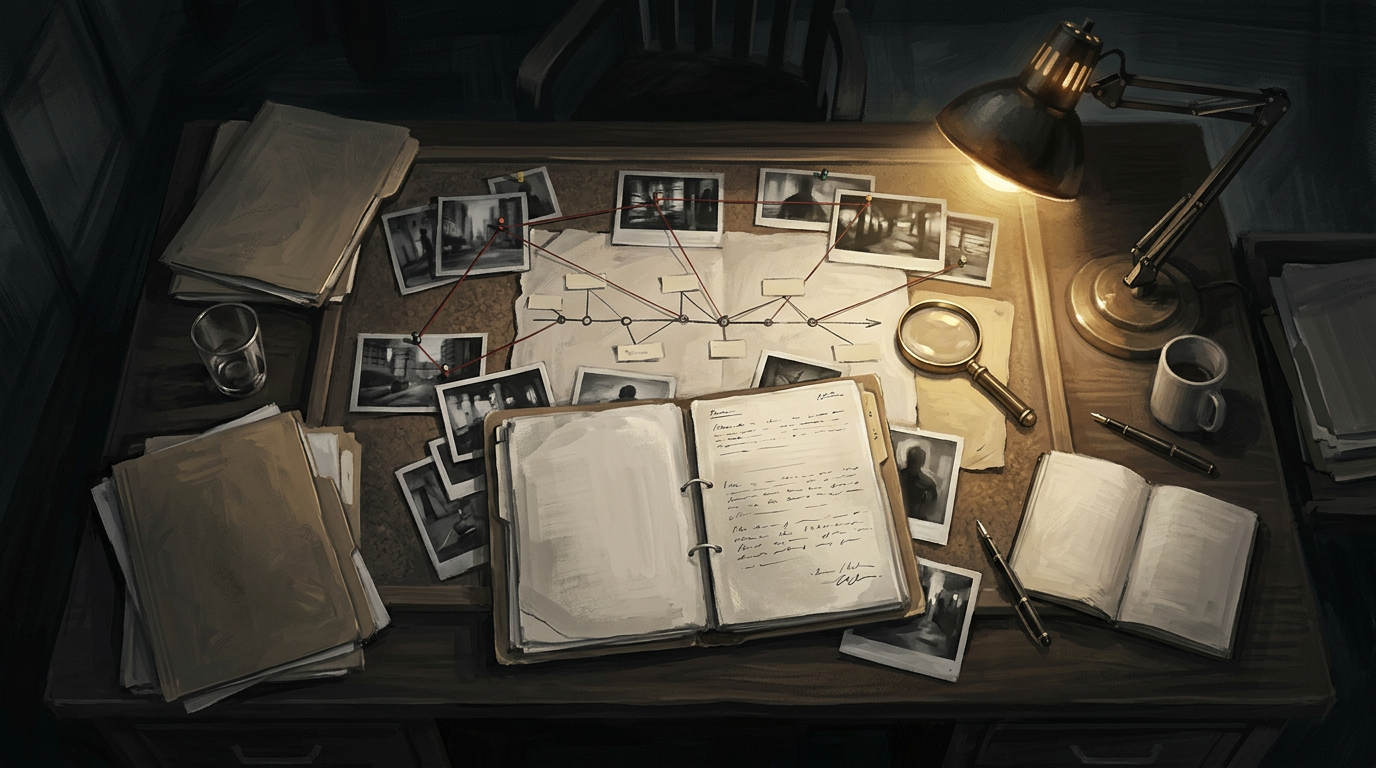
Online detective games let you investigate a mystery in a browser or through an online service, usually by reviewing clues, weighing statements, and deciding what happened. The best choice depends on whether you want a quick puzzle, a longer case file, or an investigation you can share with other players.
Key takeaways
- Check whether a game runs in your browser, needs a download, or requires an account.
- “Free” may mean a daily puzzle, a free first case, or access to a limited selection; check before you begin.
- Look for real deduction: evidence, timelines, alibis, and contradictions should matter more than clicking every object on a screen.
- Choose a case length and player format that suit the evening you have.
- Take notes, build a timeline, and separate what you know from what you merely suspect.
What are online detective games?
Online detective games are mystery investigations played through a website, app, or connected game platform. Players take on the role of an investigator: they inspect evidence, compare accounts, test timelines, and reach a conclusion. Some are compact logic puzzles; others unfold through case files, suspect interviews, or a sequence of linked discoveries.
The phrase covers several very different experiences. A hidden-object game may ask you to find items in a scene. A daily mystery may give you a short set of clues and a limited number of guesses. A case-file game may offer a larger dossier to examine at your own pace. The label alone does not tell you which kind you are getting.
A useful distinction is whether the game asks you to deduce or simply locate. Finding a detail can be part of an investigation, but deduction begins when that detail changes what you believe about a statement, an alibi, or the order of events.
How to choose online detective games
Before starting, check four practical things: access, cost, format, and commitment. Those details determine whether a mystery fits a quiet ten-minute break or an evening spent with a notebook and a suspicious cup of tea.
| What to check | What it tells you | A useful question |
|---|---|---|
| Browser or download | How quickly you can begin | Can I play directly in a browser? |
| Free access | What is included at no cost | Is the whole game free, or only the first case? |
| Case length | How much time to set aside | Is this a short puzzle or a long investigation? |
| Player format | Whether you play solo or with others | Is co-op actually supported, or are players sharing a screen? |
| Deduction style | What you will do during play | Do clues and statements connect, or am I mainly searching scenes? |
The range is broad. DetectiveOS’s roundup compares browser options from daily puzzles to longer case files; its highlighted full-file investigations are described as taking around 1½–2½ hours. That is one guide’s estimate, not a universal standard. Other services offer far shorter sessions: Midnight Casebook describes its daily cases as taking about 10 minutes and gives players three accusations.
For a browser-first starting point, CaseZero offers Case #0001, The Last Guest, free, with no account or download required. Its teaser reads: “Six people sat down to dinner. Five of them lied about it.” If you want more than the free case, Case Pack 01 includes The Silent Floor, Dead Letter, and The Second Key for €12.99. Check the CaseZero case library for the public case listing.
What does a good detective-game investigation involve?
A satisfying investigation gives clues a purpose. You should be able to move from collecting information to interpreting it, then test your interpretation against other facts. The exact interface varies, but a practical loop looks like this:
1. Read the case before chasing a theory
Start with the basic facts and note what is confirmed. Record names, times, places, and claims without immediately deciding who is lying. An early hunch is useful as a question; it is not evidence.
2. Examine evidence with a specific question in mind
Read each document or inspect each clue carefully. Ask what it establishes, what it does not establish, and whether it supports a statement. A clue that seems important may only narrow the possibilities. Do not make it prove more than it can.
3. Compare statements and build a timeline
Put events in order. Mark statements that depend on another event having happened first. Then check whether each account fits the timeline. A contradiction can be meaningful, but it can also be a misunderstanding, an uncertain memory, or a detail that has not yet been explained.
4. Test competing explanations
Try to make more than one suspect or theory fit the known facts. Then look for the evidence that separates them. If a theory requires you to ignore a clue or invent an unseen event, it may be weaker than it first appeared.
5. Make a conclusion only when the evidence supports it
Before an accusation, review your strongest facts and ask whether they support the conclusion together. The point is not to guess the most dramatic answer. It is to find the explanation that accounts for the evidence with the fewest unsupported assumptions.
For a more detailed method, see CaseZero’s guide to solving a murder mystery step by step. The same habits apply to fictional cases of any size: observe, record, compare, and revise.
Can you play online detective games for free, without a download?
Often, yes—but those are separate questions. A game may run in a browser while still charging for some cases. It may offer one free investigation but require an account for further play. Or it may be free to access while offering optional paid content. Read the access details rather than relying on a “free” label.
CaseZero’s free entry point is Case #0001, The Last Guest. It requires no account to start and no download, according to the CaseZero homepage. Case Pack 01 is a separate paid pack priced at €12.99 and contains three named cases: The Silent Floor, Dead Letter, and The Second Key. That is a clear distinction between a free first case and a paid case pack—not a claim that every case is free.
Device support can be less obvious. Browser play may work across devices, but layout, controls, and readability still matter. Check the game’s own device information if you plan to play on a phone or tablet. For comparison, PLAY INQUEST says it supports browser play on desktop, tablet, and mobile, and offers signed-in players a two-player co-op room. Those are details for that service; do not assume they apply to every browser mystery.
Solo, co-op, or a group around one screen?
Solo play suits anyone who wants to set the pace and keep their own notes. It also makes it easier to follow a long chain of evidence without negotiating every theory aloud. Co-op can help when players notice different details, but it works best when everyone has access to the same information and a way to discuss it.
A group can also play a single-player game together by sharing a screen. That can be fun, but it is not necessarily the same as a designed co-op mode. Before inviting friends, check whether the game supports multiple players, whether progress is shared, and whether each person can inspect the same clues.
For a fair group investigation, give each player a role: one tracks the timeline, one records statements, and one checks how the evidence supports each theory. Rotate those jobs if the case is long. It keeps the loudest guess from becoming the official answer by default.
Common mistakes that weaken a deduction
- Treating suspicion as proof. A character can seem evasive without being responsible for the central mystery. Ask what specific fact supports your conclusion.
- Skipping details that look ordinary. A date, a sequence, or a small difference between two accounts may matter more than a dramatic clue.
- Building a timeline from memory. Write down times and event order. Memory quietly edits the record, usually in favour of the theory you already like.
- Confusing a contradiction with a complete explanation. Finding that two claims cannot both be true is progress, not necessarily a final answer. Work out what the inconsistency establishes and what remains uncertain.
- Assuming every online mystery has the same rules. Some offer hints, some limit accusations, and some are designed for one short session. Check the instructions before spending your guesses.
- Choosing a game by “free” or “online” alone. Those words say little about case length, player format, or how much deduction is involved. Look for a description of the actual play loop.
A good habit is to keep two columns in your notes: confirmed and possible. Move a theory across only when a clue supports it. This small bit of discipline can make a mystery feel fairer—and prevent a neat but unsupported story from taking over the case.
How to start your first case
Pick a format that matches the time you have. For a short session, choose a daily or compact puzzle. If you want a fuller investigation, look for a case-file format and allow time to read and compare the material. If you are playing with someone else, confirm whether the game supports co-op or whether you will be sharing one screen.
Then make the first pass slowly. Read the premise, note what is known, and resist looking for a culprit before you understand the evidence. Keep a timeline as you go, and update it when a new fact changes the order of events. When you reach a conclusion, check that it accounts for the important clues rather than simply fitting your favourite theory.
CaseZero’s free Case #0001, The Last Guest, is one browser-based place to begin without an account or download. Its teaser offers a dinner table, six people, and a conspicuous shortage of truthful accounts; the investigation itself is yours to work through. When you want more cases, Case Pack 01 is available for €12.99. No need to rush. The clues will keep their counsel.
Online detective games are at their best when the rules are clear and the answer grows from the evidence, not guesswork. Check access, format, and case length before you start, then take notes and test your assumptions. Choose a case, open the file, and see what the evidence is willing to say.
This video is hosted by YouTube. Loading it shares your IP address with Google and may set cookies.
Questions from the squad room
Can I play online detective games for free?
Yes, some online detective games offer free daily puzzles, a free first case, or a limited selection. The word “free” does not always mean the full library is included. Check the game’s pricing and case list before starting. CaseZero’s Case #0001, The Last Guest, is free to play and requires no account to start.
Do online detective games require a download or account?
It depends on the game. Many browser-based mysteries can be played without installing an app, while some services require an account for progress, extra cases, or multiplayer features. Check both requirements separately. CaseZero says its free Case #0001, The Last Guest, needs no download or account to start.
Are online detective games suitable for mobile?
Some are designed for mobile browsers, but support and usability vary. A game may technically open on a phone while its documents or controls are easier to use on a larger screen. Look for the developer’s device information before beginning. If you plan to investigate with friends, also check whether the game supports shared or co-op play.
How long does an online detective game take?
There is no standard length. Daily mysteries can be designed for a brief session, while detailed case files may take an hour or several. Check the game’s own estimate and consider how much reading or note-taking it involves. For example, Midnight Casebook describes its daily cases as taking about 10 minutes; other formats are substantially longer.
Are online detective games the same as hidden-object games?
Not necessarily. Hidden-object games focus on locating items in a scene, while deduction-led detective games ask you to interpret clues, compare accounts, and test a timeline. Some games combine both approaches. Read the gameplay description and look for evidence analysis or suspect statements if you want a mystery where reasoning drives the investigation.
More from the Casebook
 Mystery games · 02 Nov 2026 · 10 min
Free Murder Mystery Games Online: 5 Worth Trying
Compare five free murder mystery games online, from daily deduction puzzles to full case files, and find the right browser mystery for your evening.
Read the file Mystery games · 02 Nov 2026 · 8 min
Hunt a Killer Alternatives: 5 Ways to Play
Hunt a Killer alternatives compared by format, price and commitment. Find a physical case file, browser mystery or free case to try first.
Read the file Detective guides · 02 Nov 2026 · 9 min
Questions to Ask a Murder Suspect
Questions to ask a murder suspect in a detective game, with a fair sequence for alibis, timelines, evidence and contradictions—without spoilers.
Read the file