Browser Murder Mystery Game: How to Choose and Play
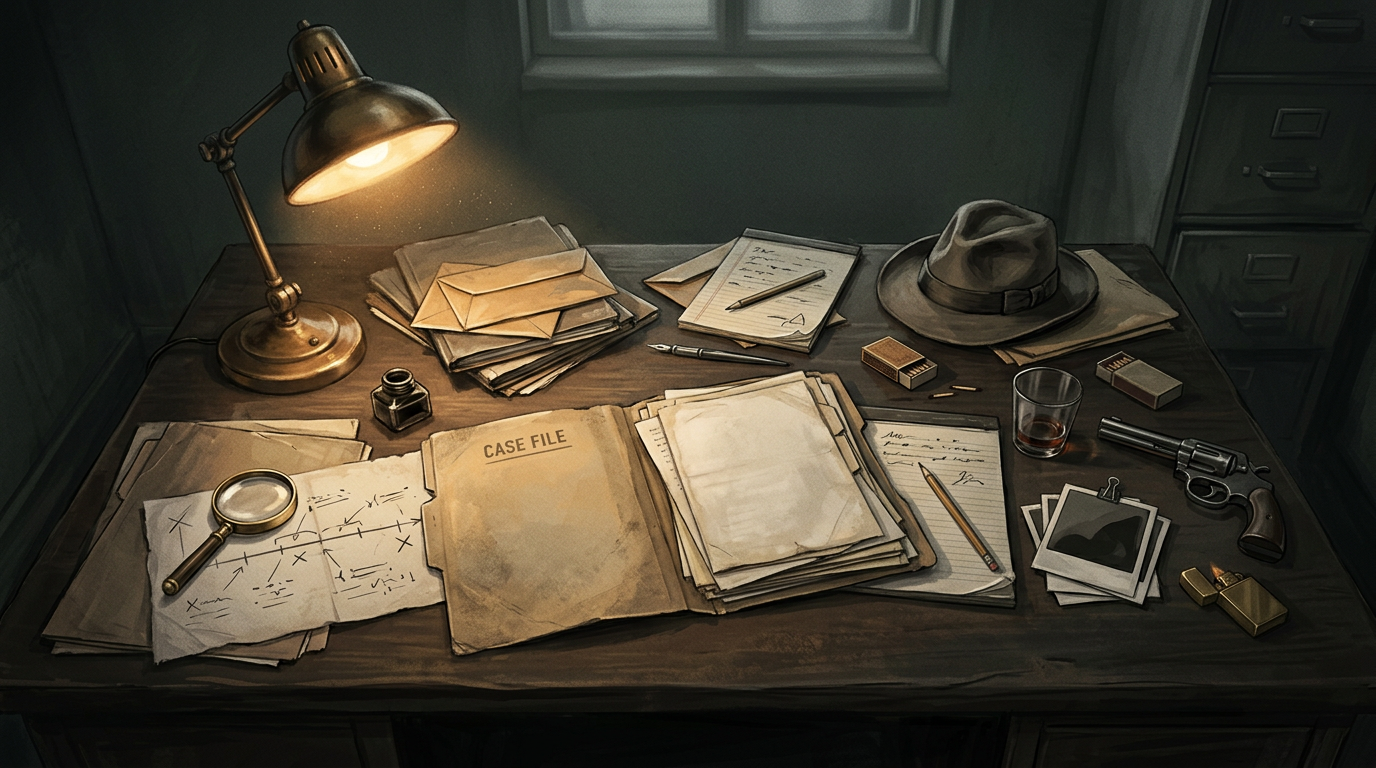
A browser murder mystery game is an investigation you play in a web browser, usually by reading case materials, examining clues and deciding what happened. The best choice depends on whether you want a quick puzzle or a longer case, and whether the evidence gives you a fair basis for your final accusation.
Key takeaways
- Check what the game asks you to do: solve a short puzzle, explore a point-and-click story, or investigate a full case file.
- Look for clear details about price, account requirements, device support and whether you can play solo or with others.
- Keep a timeline and separate confirmed facts from assumptions; a plausible story is not necessarily a proven one.
- Treat red herrings as leads to test, not facts to build your whole theory around.
- Try a free case before paying when one is available. CaseZero offers the free case #0001, The Last Guest, with no account required to start.
What is a browser murder mystery game?
A browser murder mystery game is a detective or whodunnit game that runs through a web browser rather than requiring a dedicated game download. The format can range from a short daily riddle to an interactive case file with statements, reports, timelines and an accusation at the end.
“Browser-based” describes how you access the game, not how it plays. A page might present a fixed sequence of clues, let you click around a scene, or ask you to review documents and question suspects. Some games are designed for one player; others invite a group to compare theories or work through the case together.
The useful distinction is the investigation loop. In a fuller case, you gather information, compare accounts, check whether times and details fit, and decide which explanation is best supported. In a short puzzle, the clues may be designed for one compact deduction. Both can be satisfying; they simply ask for different amounts of attention.
A browser game can be convenient, but convenience does not guarantee a good mystery. The important test is whether the evidence is understandable and the conclusion follows from what the game gives you—not from a hidden rule or a lucky guess.
How do you choose a browser murder mystery game?
Start with the kind of evening you want. A daily puzzle may suit a brief break, while a case file can take considerably longer. For example, Forgotten Mystery’s guide to browser mystery games estimates daily puzzles at roughly 5–10 minutes and says a full case file can take an evening. Those are the publisher’s estimates, not a universal measure; check each game’s own description.
Then compare the practical details before you begin. “Playable online” does not automatically answer whether you need an account, whether a case is free, or whether the interface is comfortable on a phone. Look for explicit answers rather than assuming every browser game works the same way.
| What to check | Why it matters | A useful question |
|---|---|---|
| Format | Sets expectations for the investigation | Is this a short puzzle, a point-and-click story, or a case file? |
| Price | Helps you understand the commitment | Is there a free case, a one-time purchase, or ongoing access? |
| Account | Affects how quickly you can start | Can you begin without registering? |
| Device | Clue comparison may be fiddly on a small screen | Does the game say it supports mobile browsers? |
| Group options | Some mysteries work best as shared investigations | Is solo play supported, or is a group expected? |
| Case length | Helps you choose a session that fits | Does the publisher provide a time estimate? |
For a concrete free starting point, CaseZero lists case #0001, The Last Guest as free, with no account required to start. Its teaser reads: “Six people sat down to dinner. Five of them lied about it.” That is an invitation to investigate, not a disclosure of the case’s answer.
If you want more than a single case, CaseZero lists Case Pack 01 for €12.99. It includes The Silent Floor, Dead Letter and The Second Key. Check the current product page for the terms that apply before purchasing; a title and price are not a substitute for reviewing the offer.
How do you investigate a browser case step by step?
A small amount of structure makes mysteries easier to follow. You do not need a wall of string; a plain note with names, times and open questions will do.
1. Read the case materials once without deciding
Start by identifying what each document is and who created it. A witness statement is a person’s account, not an objective recording of events. A log may be precise about a recorded time while saying little about what happened around it.
On the first pass, mark names, places, times and claims that could be checked later. Avoid picking a suspect simply because the story introduces them dramatically. Theatrical entrance is not evidence.
2. Build a basic timeline
Write the relevant events in chronological order. Leave uncertain times marked as uncertain instead of forcing them into a neat sequence. Add the source beside each entry so you can return to the document that supports it.
A simple table works well:
| Time or order | Claim | Source | Confidence |
|---|---|---|---|
| 8:10 | A person says they arrived | Statement A | Reported, not confirmed |
| 8:20 | A system records an entry | Access log | Recorded event; identity may need checking |
| Unknown | A second person says they were alone | Statement B | Unverified account |
The point is not to make every detail look certain. It is to see where the record is firm, where it is disputed and where there is a gap.
3. Separate observation from interpretation
“Two entries appear in the log” is an observation. “The suspect made both entries” is an interpretation that needs support. Keeping those apart prevents an early theory from quietly turning into a supposed fact.
You can use three labels in your notes: confirmed, claimed and inferred. Confirmed means the case material directly establishes the point. Claimed means someone says it happened. Inferred means you have connected details to draw a conclusion. The last category can be valuable, but it should remain open to revision.
4. Compare accounts and ask focused questions
When the game allows interviews, ask questions that test one detail at a time: where someone was, when they left, what they saw, or how they know a particular fact. Broad questions can produce broad answers; precise questions are easier to compare with a document or another account.
A useful interview sequence is: establish the person’s version, identify a specific point that can be checked, then ask about the difference. Do not treat a contradiction as proof of guilt. People can be mistaken, vague or protective of an unrelated secret. The contradiction is a lead; the surrounding evidence determines what it means.
For more examples of focused prompts, see this guide to questions to ask a murder suspect. Use questions to test the record rather than to fish for a confession.
5. Test more than one explanation
Before accusing anyone, write down at least two plausible explanations for the important clues. Then ask what each explanation accounts for—and what it leaves unexplained. A strong theory should fit the timeline and the relevant evidence without needing several unsupported assumptions.
This is also how you handle red herrings. A detail may be genuinely suspicious and still be unrelated to the central event. Keep it in view, but do not let it outweigh stronger evidence merely because it is memorable.
6. Make the accusation only when the evidence holds together
Review your timeline and notes. Can you explain why your chosen account fits better than the alternatives? Can you point to the information supporting each important step? If your conclusion depends on a detail the case never established, pause. A confident guess is still a guess, only better dressed.
What makes a mystery fair—and what should you expect from AI dialogue?
A fair mystery gives players the information needed to reach its solution. That does not mean every clue is obvious or that every witness is reliable. It means the final explanation should make sense of the relevant evidence already presented, rather than relying on a decisive fact introduced only after the accusation.
Fairness also leaves room for uncertainty. A case can include inaccurate statements, missing information and details that point in more than one direction. The player’s task is to weigh them, not to assume every sentence is equally trustworthy. Before committing to a theory, check that it explains the central evidence and that you have not mistaken an inference for a confirmed fact.
Some browser games use AI-generated dialogue, while others use fixed scripts or documents. If a game offers open-ended interviews, look for an explanation of how conversations relate to the case evidence. In any mystery, dialogue should help you examine the established record—not become an uncheckable source of new facts that can change the answer. Do not assume every AI feature works the same way; read the game’s own description and disclosures.
For a comparison of formats, Forgotten Mystery groups browser offerings into interactive case files, point-and-click mysteries, multiplayer deduction games and daily puzzles. The variety is useful, but it means “mystery game” alone tells you little about the kind of reasoning or session the game expects.
Can you play alone, with friends, or on a phone?
That depends on the individual game. Some case files can be investigated solo, while group formats may be built around discussion. Do not infer multiplayer support from a mystery’s subject matter; check the listing for the intended player count and whether a shared session is actually supported.
Publishers sometimes provide concrete scope information. For example, Cold Murder Mystery says its cases contain 26 documents and can be played solo or in groups of 2–8. Those figures describe that service, not browser mysteries as a whole. Likewise, MurderMysteryTime estimates that its cases take 30 minutes to over an hour, depending on difficulty and how thoroughly players investigate. Treat time estimates as guidance, not a stopwatch guarantee.
On mobile, the main practical issue is often comparison: switching between a statement, timeline and other clue can be less comfortable on a small screen. A phone may be fine for reading, while a larger display may make cross-checking easier. If mobile support matters, look for an explicit statement from the publisher and, where possible, try a free sample before paying.
For group play, agree on a shared note-taking method. One person can record the timeline while others review statements, but everyone should distinguish evidence from theory. Otherwise, the loudest guess can acquire the appearance of a fact. Mystery is atmosphere; group bookkeeping is less glamorous and considerably more useful.
A fair mini mystery: what can the clues prove?
Use this original practice puzzle to try the method. It is self-contained: every fact needed to solve it appears below. Read the evidence first and decide what it supports before opening the solution.
At a small archive, a sealed envelope is found missing from a locked reading room after the 4:00 p.m. closing check. Three staff members had access to the corridor that afternoon: Ada, Ben and Cleo. The room’s key stayed on a hook at the desk.
The case file gives four facts:
- The corridor log records Ada entering at 3:40 p.m. and leaving at 3:45 p.m.
- The same log records Ben entering at 3:50 p.m. and leaving at 3:55 p.m.
- Cleo’s signed inventory at 3:58 p.m. says the envelope was in its marked tray.
- At 4:05 p.m., the closing clerk found the tray empty. The clerk’s note says the room was locked at 4:00 p.m.
Ada says she checked the reading-room clock while inside and it showed 3:40. Ben says he never entered the room, only the corridor. Cleo says she completed the inventory at 3:58 and did not return to the room after that.
Before reading on, ask: what is definitely established, what is only claimed, and what cannot be concluded from these facts? In particular, do the entries show who entered the room, or only who entered the corridor? Does the evidence establish when the envelope disappeared? Do not fill gaps with a convenient theory.
Solution
The clues establish that the envelope was recorded in its tray at 3:58 p.m. and was missing by 4:05 p.m. They do not establish which person removed it. The log concerns the corridor, not entry into the reading room, and no clue says who used the key or whether anyone entered between the inventory and the closing check.
That is the fair conclusion: the responsible person cannot be identified from the evidence provided. Ada’s clock comment, Ben’s denial and Cleo’s inventory may invite suspicion, but none proves who took the envelope. A sound investigator does not turn an incomplete case into a solved one by choosing the most theatrical possibility. In a real game, look for enough evidence to support the accusation; if the record leaves a decisive gap, the gap matters.
Common mistakes—and a better way to play
Treating a claim as a fact. A suspect’s statement tells you what they say; it does not automatically verify the event. Record the source and seek corroboration.
Building the timeline around a preferred suspect. Start with the documented order of events, not a theory. If a new clue changes the sequence, update your notes rather than bending the clue to fit.
Overvaluing a contradiction. A false or inconsistent statement can matter, but it does not by itself prove the central accusation. Ask whether the contradiction connects to the key event and whether other evidence supports that link.
Ignoring what the evidence cannot show. A record can establish a time without establishing a person’s identity, or establish presence without proving an action. Be exact about the limits.
Rushing the purchase or the accusation. Check the format and price before paying, and review your evidence before submitting a final answer. CaseZero’s free #0001 The Last Guest is a no-account starting point; for a larger commitment, Case Pack 01 is listed at €12.99 and contains The Silent Floor, Dead Letter and The Second Key.
A good browser mystery gives you a case to examine, enough structure to test your ideas and a conclusion that can be supported by the clues. Choose the format that suits your time, keep a careful record, and let evidence—not atmosphere alone—decide the case. Ready to open a file? Start with CaseZero and its free case #0001, The Last Guest.
This video is hosted by YouTube. Loading it shares your IP address with Google and may set cookies.
Questions from the squad room
Can I play a murder mystery game in my browser without downloading anything?
Many browser mystery games are designed to run in a web browser, but access requirements vary. Check the game’s own page for download, account and device requirements before starting. For example, CaseZero lists case #0001, *The Last Guest*, as free with no account required to start.
Are there free browser murder mystery games?
Yes. Some games offer a free case or sample, while others charge for individual cases or access to a catalogue. Confirm what the free option includes before investing time. CaseZero lists #0001, *The Last Guest*, as free, and lists Case Pack 01 at €12.99.
Can I play a browser murder mystery game alone?
Some browser mysteries support solo investigation, while others are made for groups or shared discussion. Check the game’s player information rather than assuming. A solo-friendly case should let you examine the clues and reach a conclusion without relying on another player to unlock essential information.
Do browser murder mystery games work on mobile?
Support differs by game, so look for an explicit mobile-browser statement. Reading documents may work well on a phone, but comparing several statements and timeline details can be easier on a larger screen. If the game offers a free case, try it on your intended device before buying additional content.
How long does a browser murder mystery game take?
It depends on the format and how thoroughly you investigate. A short daily puzzle can take only a few minutes, while a full case file may take much longer. One guide estimates daily puzzles at roughly 5–10 minutes and a complete case file at an evening; treat publisher estimates as guidance, not a guarantee.
How can I tell whether a mystery has a fair solution?
A fair mystery gives you enough evidence to support its conclusion, even if some clues are ambiguous or some witnesses are unreliable. Track the source of each claim, separate facts from inferences, and ask whether your theory explains the central evidence without relying on a decisive detail the game never established.
More from the Casebook
 Mystery games · 15 Nov 2026 · 8 min
Murder Mystery Games With No Subscription: A Practical Guide
Murder mystery games with no subscription: compare free cases, one-time purchases, formats and practical details before choosing your next investigation.
Read the file Mystery games · 14 Nov 2026 · 9 min
Murder Mystery Game Like an Escape Room: How to Choose and Play
Murder mystery game like an escape room? Compare formats, learn the investigation steps, and find a browser-based case you can try for free.
Read the file Mystery games · 13 Nov 2026 · 9 min
Solo Murder Mystery Game Online: A Practical Guide
Choose a solo murder mystery game online with confidence. Compare formats, learn a fair investigation method and find a browser case to try.
Read the file